


A deadly winter for stray cats comes to an end
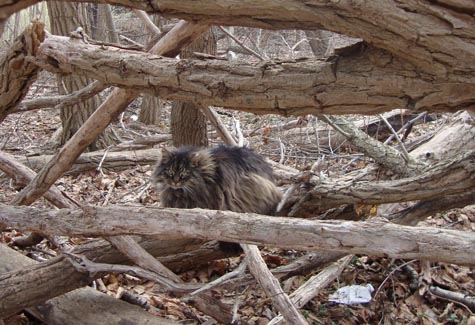
North Fork’s feral cat colonies rely solely on big-hearted volunteers to survive the colder months. And this winter — which saw record snowfalls — has been a particularly harsh one for the felines, according to volunteers who care for them. Several feet of snow that persisted from late December well into February buried kittens and cats in their own shelters or blocked the strays from reaching feeding stations.
To help the cats eat and keep warm, volunteers shoveled long pathways through the snow, tossed hot water over thick ice on feeding stations and scrambled to rebuild plow-damaged shelters in biting cold.
Despite their efforts, several cats and kittens died.
“It’s been brutally sad when we find dead cats and kittens,” said Rosalie Basile of Wading River, a volunteer who cares for feral colonies. “It’s especially sad when it’s a cat or a kitten you have been feeding for a long time. It’s the cold and wet combination too. If the cats can’t get dry, they will freeze like a Popsicle.”
There are two animal rescue groups in Southold and Riverhead towns. Workers from SAVES Inc. (Volunteers with Spay, Alter, Vaccinate Every Stray) say they feed about 40 colonies each day, 500 cats in all. Those with RSVP (Responsible Solutions for Valued Pets, Inc.) care for about 10 colonies every day, about 200 cats, across the North Fork. They also get support from the Kent Animal Shelter in Calverton and the North Fork Animal Welfare League in Southold.
The volunteers are reluctant to identify where colonies live, fearing that people will harm them.
Aside from muscling through a persistent snowcover, volunteers have had to make more than their usual twice-daily trips this winter to feed and hydrate the cats, which for the most part live in wooden shelters or plastic tubs supplied by the organizations. During one of several snowstorms that made January the snowiest on record, a snowplow overran and destroyed one colony’s shelters and feeding stations.
No matter the season, the life of a feral cat is hard, say the volunteers. “The average life of a feral cat is five years because they are subject to all the dangers of the environment” said Ms. Basile, who works with RSVP.
The cats can contract internal and external parasites and diseases such as feline aids and leukemia, she said. They have fights with raccoons and other animals living in the wild. Extreme weather conditions will make it especially hard for them to defend themselves or hunt for food — if they’re not being fed by rescue organizations. Hawks can carry them away in the daytime while owls prey on them at night.
The volunteer groups face constant financial pressures.
If a person can prove he or she has been feeding a colony, or is trying to maintain it by providing shelter, feeding stations and medical care, the North Fork Animal Welfare league will supply food for the cats. It costs the league $1,500 to $2,000 a month.
RSVP volunteers must each supply food for the colonies. The cost depends on how many cats they feed. If a volunteer can’t afford to feed the cats, they must ask another volunteer for help. Pet stores will sometime donate food that has been returned, or packages that have been opened or damaged.
For the most part, abandoned pets start feral colonies. Unless the females cats are spayed and males neutered, their populations will skyrocket if well intentioned people feed them.
Debbie Corsair of Southampton, the volunteer coordinator at the Kent Animal Shelter, recalled the case of a woman who was feeding an abandoned cat but did not try to capture it and have it spayed. In less than a year, the cat had five female kittens that each produced about five more. The woman moved away and left the landlord with several cats living on his property. SAVES volunteers and the Kent shelter got involved. The cats were trapped, spayed and neutered.
“Without intervention there would perhaps have been another 50 cats,” Ms. Corsai said. “Picture yourself the woman’s neighbor with 50 cats running through your backyard. In no time there is dissension.”
Tom Scheibel of Brookhaven, a veterinarian for Kent for more than a decade, said people are not very well informed about to the necessity of spaying and neutering a cat. Educating the public is just as important as the work of volunteers who try to feed the animals, he said.
“Every cat you spay takes away the potential for that cat having six or seven litters during its life span,” Dr. Scheibel said.
A certain amount of animal psychology goes into caring for feral cats, which first must come to trust whoever is trying to care for them. Once that barrier is crossed, the volunteers can trap the cats and have all of them spayed and neutered. All are vaccinated for rabies. Young kittens are taken out of the wild so they can be socialized and put up for adoption.
Mary Johnson, a SAVES volunteer from Mattituck, said kittens born to feral mothers must be taken out of the wild when they are no older than four weeks, or they risk becoming too feral to tame. Aside from their work in the field, volunteers also work with rescued kittens that need exposure to human touch to socialize them and prepare them for adoption.
