Spotted lanternflies surging on North Fork — but vineyard damage remains limited
If it seems like there are more spotted lanternflies hopping around the North Fork this summer, you’re not imagining it.
The invasive pest continues to become more established farther east on Long Island, according to Cornell Cooperative Extension entomology expert Jared Dyer.
While sightings are increasing, Mr. Dyer said the lanternfly population has not yet reached levels causing widespread agricultural damage on the North Fork. Grapevines remain the biggest concern for local growers. As the insects feed, they leave behind a sticky substance known as honeydew that can promote the growth of sooty mold, he said.
And colder weather won’t make the problem disappear. Mr. Dyer urged residents to scrape accessible egg masses from hard surfaces. The egg masses are roughly an inch long and can appear gray, brown, waxy or mud-like.
“They’re hitchhikers,” said Nikki Vivion, ReWild Long Island’s North Fork chapter lead. “They will lay their eggs on cars [and make their way around the island].”
At Paumanok Vineyards, owner and winemaker Kareem Massoud said the vineyard has seen more lanternflies this year, but the insects remain more a nuisance than an economic threat.
“We first started seeing them a couple of years ago, but very limited numbers,” Mr. Massoud said. “Then last year, we saw more, and there’s definitely more this year than last year. But still no infestations. We’re seeing them here and there, but not in great numbers. When one vine is totally covered with them, where you can barely even see the trunk anymore because it’s just covered in bugs — we have not seen that yet.”
Mr. Massoud said the vineyard remains in a “wait-and-see phase,” though he expects to see even more lanternflies next year.

“We haven’t seen dramatic vineyard damage on Long Island like they saw in some of those early cases in Pennsylvania,” Mr. Dyer said, giving local growers some reason for relief.
The lanternflies haven’t made their way to completely east, as Pindar Damianos, the owner of Pindar Vineyards in Peconic, hasn’t found many.
“I’m not seeing them jump all over the place, like, in a big plume at the vineyard right now, but they’re bound to be here at some point,” Mr. Damianos said.
Spotted lanternflies are invasive plant hoppers native to Asia that feed on the sap of plants and trees — particularly tree-of-heaven and grapevines. They’re also attracted to maples, willows, walnuts and a variety of other plants.
Mr. Dyer said the adults are more noticeable than their earlier life stages because they’re larger and more colorful. The nymphs are smaller, wingless and tend to hop rather than fly.
Homeowners don’t need to panic, Mr. Dyer said. If you see them, the recommendation is to crush or stomp on them. For larger numbers around a home, a vacuum can work. Mr. Dyer suggested a backpack vacuum or shop vac as an effective, quick and nonchemical localized method.
Nancy DePas Reinertsen, a Master Gardener and ReWild Long Island board member, said some residents also use a soap-and-water mixture on the insects. Mr. Dyer’s advice, however, focused on physically removing or killing lanternflies and scraping away their egg masses.
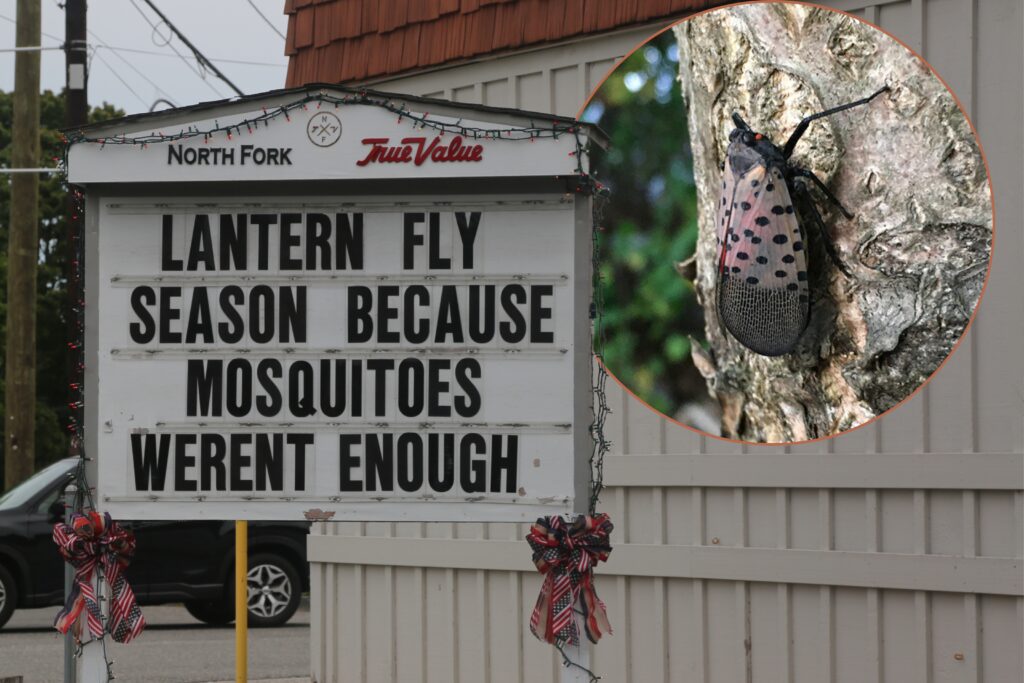
North Fork True Value, a hardware store in Jamesport, rotates amusing signs every month or so.
Manager Katie Sorady, at the start of August, hung up a sign that read, “Lanternfly season because mosquitoes weren’t enough.”
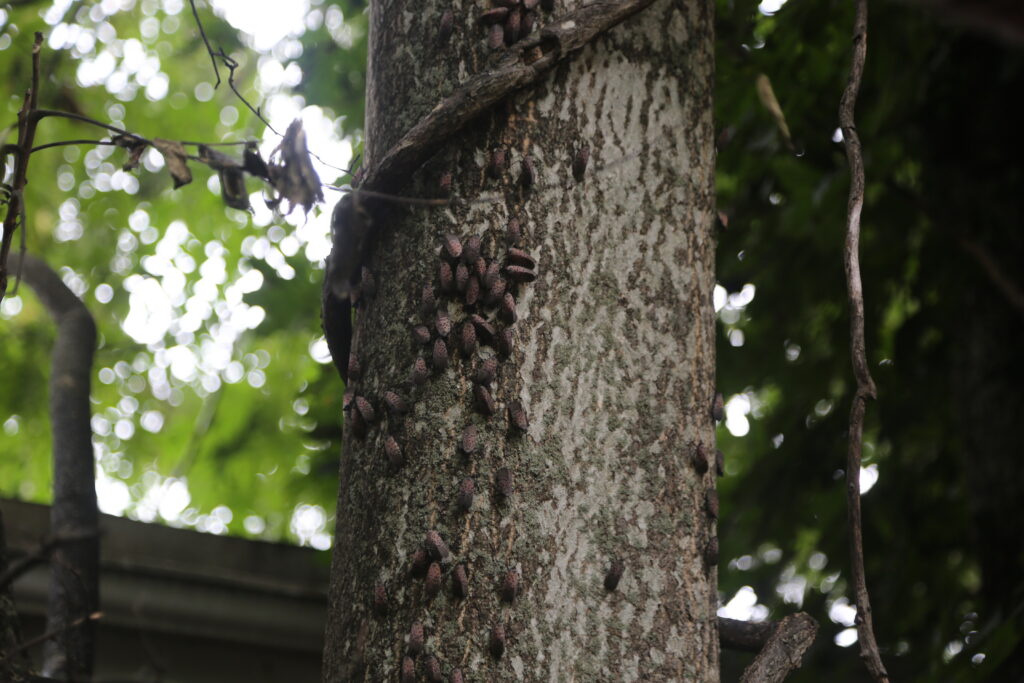
“I just thought it was relevant to what everyone’s dealing with right now,” Ms. Sorady told the Riverhead News-Review, adding that adult lanternflies had infested a tree at the back of her property.
Natural predators may eventually help keep the population in check. Some birds have already begun eating lanternflies, according to Mr. Dyer.
“We’re trying to slow the spread in new areas and buy time until other management options are available, until we have better biological control, until natural enemies start to adapt and lower this population,” Mr. Dyer said.