Riverhead board trims Halpin’s proposed 2027 tax-levy hike to 1.79%
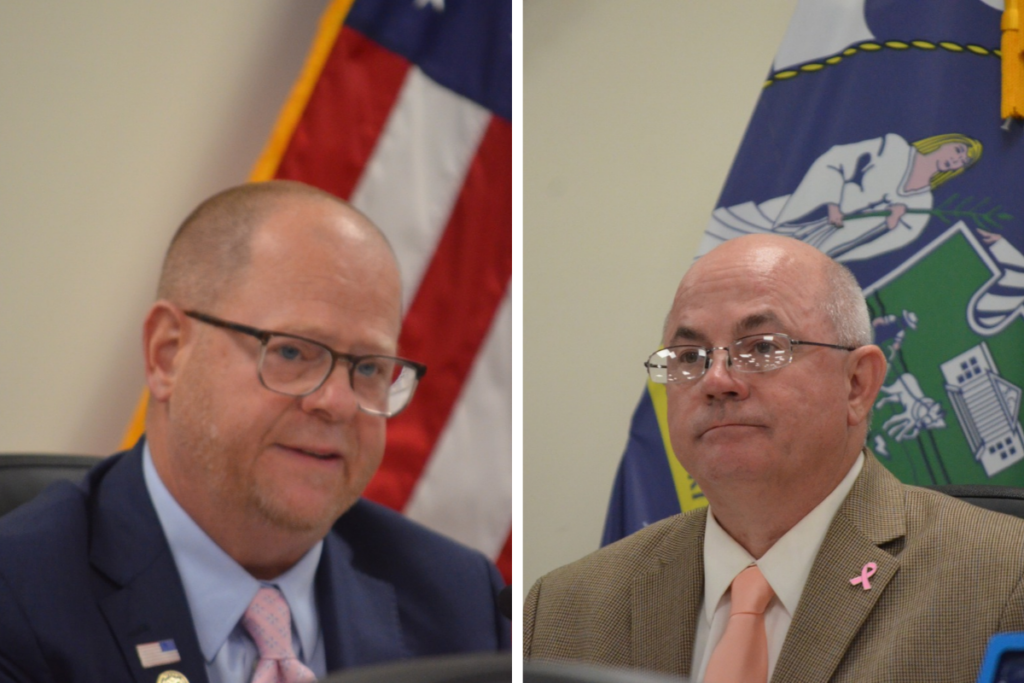
The Riverhead Town Board passed Councilman Ken Rothwell’s six amendments to Supervisor Jerry Halpin’s $121 million preliminary budget for 2027, cutting the proposed 2.79% tax-levy increase to 1.79% — a roughly 36% reduction in the size of the increase.
Mr. Halpin abstained on five of the amendments, citing disagreements over the use of fund balance, concerns about future budget risks and what he described as political motivation by Republican board members. He voted yes on one amendment regarding the Street Lighting District’s tax levy.
The proposed budget is the first Mr. Halpin has put forward for 2027 and would end four consecutive years in which Riverhead overrode the state tax cap. He defeated Republican incumbent Tim Hubbard by 37 votes last November and faces Mr. Rothwell next month.
“We did present a budget that does not pierce the tax cap, but when I say we, I say it because all of us were in those meetings — in fact, I added additional meetings, so that every department head and liaison could have their voice heard more,” Mr. Halpin said. “The ironic thing is that most of those meetings, they included my fellow board members, oftentimes advocating for adding costs to the budget.”
Mr. Rothwell submitted the revisions at last Thursday’s work session, proposing to lower the levy increase by about one percentage point. The overall increase would be 1.79%, while the General Fund — the town’s largest operating fund — would rise by 1.73%. The overall figure includes several entities, including street lighting and highway, Mr. Rothwell said.
The primary goal of these amendments is to lower the tax levy without cutting essential services and utilize the fund balance without lowering it, Mr. Rothwell told the Riverhead News-Review on Monday.
The tax levy is the amount raised through property taxes. Under Mr. Halpin’s tentative proposal, the combined property tax levy of the three main townwide funds — general, highway and street lighting — would rise $1.70 million, or 2.79%, to $62.88 million.
Mr. Rothwell’s amendments decrease the townwide tax levy by just over $643,000, he confirmed in a phone interview on Monday.
Citing the $4.8 million in investment returns from the town’s fund balance last year, Mr. Rothwell explained the interest earned will be used for one-time purchases, such as mechanical equipment for the fire marshal and a new vehicle for building and grounds.
The first amendment removes $53,300 from building and grounds equipment, $50,000 from fire marshal equipment and $55,000 for refuse vehicles, reducing the General Fund property-tax levy by $158,300.
“To keep putting things in the budget would be overtaxing our residents, so we’re not going to do that,” Mr. Rothwell said at Tuesday’s town board meeting. “This one-time adjustment takes that out of the preliminary budget, it’ll be a fund balance transfer in January.”
Before abstaining to the first resolution, Mr. Halpin challenged the claim that the purchases were truly “one-time” expenses, saying the town buys this type of equipment every year. He cautioned against removing recurring expenses from the budget and relying on fund balance.
“This type of budgeting can come back to bite us in years ahead,” the supervisor said, citing the lack of a budget increase in 2022, which resulted in the need to add over $2 million from fund balance in 2023. “That’s the hole that we’re still digging out of.”
He also pointed to reduced budget lines, including the salt budget and equipment lines for the town’s highway department. He said Mr. Rothwell had argued against the reductions, and that the highway budget had been over the tax cap until the supervisor reviewed the line items with the financial administrator and deputy town attorney Annemarie Prudenti. She approached reporters after the meeting to clarify that she had not been involved in the budget process.
The second budget amendment would add $1,949 to the General Fund tax levy to cover an additional merit increase requested by the town highway superintendent for an administrative employee, including Social Security and retirement costs.
Regarding the cost-of-living increases for some clerical employees, Mr. Halpin said while he stood behind the board’s decisions, but felt “everyone in this building deserves a raise.”
“We looked at those things, I met with people, and we had to make tough choices,” Mr. Halpin said, before abstaining. “To pick that was just not where I wanted to see that money go.”
Mr. Halpin’s budget proposal does not include raises for elected officials, but does include 76 merit raises, nine promotional raises, six new full-time positions and two new part-time positions in the town’s general fund.
The third budget adjustment would reduce the General Fund tax levy by $395,941. It includes $165,941 for building inspection fees, $250,000 in interest and earnings, and $50,000 in fines and forfeited bail. The amendment also reduces the amount of fund balance used to support the budget by $70,000.
Mr. Halpin questioned why similar efforts to lower taxes had not been made before he stepped into office.
“I feel like this is rooted in political motivation,” the supervisor said. “I can’t stand behind this decision or the risk being taken to think beyond us as residents and to a party, so I abstain again.”
Another adjustment would transfer $5,392 from the Highway Fund’s snow-contractual account to cover an employee promotion and a merit raise for another. It would not change the tax levy. Mr. Halpin said he had been asked not to revise the snow-contractual budget in preparation for another bad winter. Citing a lack of clarity, the supervisor abstained.
Mr. Halpin voted yes on an amendment that would reduce the Street Lighting District’s tax levy by just over $91,000. Mr. Rothwell is proposing to use the Street Lighting fund balance to pay for equipment.
“The street lighting budget has an enormous amount of reserves,” Mr. Rothwell said. “We are putting together a project for the [Wading River] Duck Ponds, we are utilizing some of that fund balance, but even then, we are way too ample in what is in the reserve balance for street lighting, and so we’re amending the budget to collect less, save taxpayers’ money.”
The final amendment would provide $120,000 in funding for an improved dental plan for CSEA workers. Councilwoman Denise Merrifield said that, while salary increases were constrained by the budget, improving the dental plan was a way to give employees something back. This budget revision would not change the tax levy.
Before he came into office, Mr. Halpin disclosed an earlier CSEA contract had been left open for a possible negotiation this year. He had discussed affordability with CSEA workers and town staff, and said they had discussed looking at it for 2028.
However, he felt the amendment before the board did not account for the full cost, including the cost to taxpayers of moving employees off the existing Delta Dental plan. He also felt two other unions, department heads and their non-union cohorts were being left out.
“I think the motivation for it is there, and I think we should be working together as a board, ” Mr. Halpin said, before abstaining for a fifth time. “I really like the idea of this, it’s something that I’m learning.”
Mr. Rothwell’s amendments were backed by the other members of the Riverhead Town Board.
“I’m very happy that we are able to come in lower than the supervisors’ [budget,],” Ms. Merrifield said. “The reductions that we’re, the Republican board, now implementing are a great benefit to the town.”
Last November, the Town Board overrode the tax cap to approve the 2026 budget, which raised the tax levy 7.74% and the townwide property tax rate 6.74%. During last year’s discussions of former supervisor Tim Hubbard’s 2026 budget, there were no adjustments due to much uncertainty when it came to the interest rates.
“Our budget, at this point it’s easier, in hindsight, to say was overly conservative, we underestimated our revenues and underestimated return on investment, and so we did really well,” Mr. Rothwell said on Monday. “Quite honestly, having $4.8 million dollars in invested returns, we could have kept the taxes a little bit lower last year, but you don’t know that until the end of the year.”
With the guidance of his personal financial advisors who reviewed the public 2027 budget, Mr. Rothwell said he was told this tentative spending plan was still “very conservative.”
Mr. Rothwell describes this year’s budgeting process as “difficult,” claiming there was a lack of communication from Mr. Halpin. Unlike previous years where the board was involved in discussions earlier, the councilman said Mr. Halpin did not share his budget intentions until they were submitted to the town clerk back in September.
“What happens is you’re much shorter on the time frame to take a closer look at everything,” Mr. Rothwell said. “There’s a very short period of time that you have to make amendments to a budget — as soon as we looked at it, we said we can do better.”
A public hearing on the preliminary budget is set for Thursday, Nov. 5 — two days after the election. The Riverhead Town Board must adopt the preliminary budget as amended no later than Nov. 20.