Riverhead weighs impacts of revised SCWA pipeline in second Monroe hearing
Despite its pipeline detour, Riverhead officials and residents remain wary of the Suffolk County Water Authority’s rerouting to Main Road — citing concerns about traffic, schools and wetlands in Aquebogue during construction.
Those concerns dominated a second Monroe Balancing Test hearing Tuesday, as town officials questioned what Riverhead stands to gain from hosting a pipeline that will not connect to its water district. A Monroe Balancing Test determines whether a government project has enough public benefit to be exempt from local zoning and land-use laws.
Jeffrey Seeman, the town’s environmental consultant, reiterated the board’s position, which has not wavered since the first Monroe hearing over a year ago: the Riverhead Town Board should retain jurisdiction over the project and be recognized under the State Environmental Quality Review Act, or SEQRA, as an involved agency.
This includes having the SCWA comply with Riverhead Town code requirements for special permit, site plan review, wetlands permits, excavation/import–export permits, highway permits, building permits, and architectural review.
“This is not a burdensome request, one would think you would have to do all this engineering just to make the plan work in the first place,” Mr. Seeman said. “There’s nothing draconian about the requirements that need to be met.”
In response to comments collected during several public scoping sessions held last year, the SCWA announced its new plan last month to send the 7.5-mile transmission line north along County Route 105 and then east beneath Main Road/State Route 25, moving it away from Sound Avenue.
The new “preferred” Main Road route is one mile shorter, moves anticipated completion up from 2030 to 2028 and still bypasses the Riverhead Water District, with no connections planned within its service area. It will also cost between $22 million and $25 million — roughly $10 million less than the original $35 million estimate.
The project is fully budgeted and will be integrated into the SCWA’s existing annual $100 million capital improvement budget. The authority also plans to seek grant funding.
SCWA plans to construct a booster station at what the DEIS describes as an “undeveloped, sparsely vegetated” property the agency owns at the intersection of Cross River Drive and Main Road in Aquebogue, rather than the previously proposed location at the intersection of Sound and Pier avenues, according to the Draft Environmental Impact Statement prepared by Nelson, Pope & Voorhis, LLC.
The water main would then be directionally drilled under Main Road from south to north and continue east along the north side of Main Road to a point near the intersection of Franklinville Road and Main Road in Laurel, where it will connect to an existing 16-inch SCWA water main.
Compared with the proposed Sound Avenue route and the third Peconic Avenue alternative, Main Road became the “preferred” route in the DEIS due to its hydraulic benefits. Its low elevation eliminates the need for a second booster, officials said, and allows for a shorter route that reduces excessive water aging in the main.
Construction on the narrow Sound Avenue corridor would also be avoided, SCWA officials explained, addressing traffic and safety concerns expressed previously.
SCWA officials said at a public hearing in Riverhead last week that the Main Road rerouting was driven in part by concerns raised during last year’s public scoping process and subsequent hearings.
“This is feedback that we heard from folks who made public comments: stay off Sound Avenue, it’s narrow, it’s historic, we can’t have a water main project disrupting commerce and the folks up there,” SCWA CEO Jeff Szabo said at the Aug. 24 hearing at Riverhead Free Library. “We heard you, we understand your concerns, and we agree that we think the state road is a much better way to go.”
During the town’s Monroe hearing on Tuesday, Mr. Seeman criticized what he called engineering deficiencies in the original Sound Avenue plan, deeming it a “hydraulic failure” from the start. He said one booster station would not have created enough pressure to overcome the 70-foot elevation change needed to move water from Southampton north toward Sound Avenue.
Because of that obstacle, a second pump station would be needed, Mr. Seeman said. He argued that was not reflected in the DEIS or SCWA’s engineering plans, and characterized the Main Road “preferred alternative” as a last-minute pivot.
Mr. Seeman asserted the SCWA is “improvising” its plans based on the engineering findings in the Environmental Impact Statement.
“Essentially what they had proposed was equivalent to a ‘no build’ because it did not meet the goals of the project,” Mr. Seeman said. “I said that the Water Authority was flying the plane while they were building it, they were also designing it with only one wing, so it was never going to fly in the first place.”
The environmental consultant continued to go into lengthy detail about how the population density impacted along Main Road is greater than it is along Sound Avenue. He cited how the project construction will be taking place just a few miles from local businesses, residential homes, Aquebogue Elementary School and sensitive freshwater wetlands such as Terry’s Creek, Sawmill Creek, and Meetinghouse Creek, which is currently undergoing a $2.2 million restoration effort.
Furthermore, officials and community members agreed the plan lacks a traffic and school safety analysis, details on potential impacts to historical structures such as the nearly 300-year-old Jamesport Meeting House, an emergency response plan for area fire responders to follow when selecting detours and alternative routes necessary to protect the public’s health and safety, and no hazardous material cleanup guidelines.
“The water authority has simply provided a stick figure as its engineering drawing for the proposed 24-inch water main,” Mr. Seeman said.
On the SCWA’s point of being “indisputably immune” to local zoning rules and land use regulations, Mr. Seeman said this is a “false statement” due to the active litigation in the state Supreme Court.
Red flags were also raised by town officials over the SCWA’s minimal intergovernmental coordination with Riverhead’s staff outside of required public hearings, as well as the lack of SCWA board presence at these key hearings and the late disclosure of the route change, which officials say they only learned when the Draft Environmental Impact Study was released in July.
“I truly believe this is the only Monroe hearing,” Councilman Kenneth Rothwell said. “It should be deemed off of what was spoken today, not what was a hearing that was held by them with no board members present.”
Frank Mancini, superintendent of the Riverhead Water District, said he was surprised to see in the plan’s drawings how close the large transmission line is to an existing Riverhead Water District main. Any excavation alongside the existing Riverhead water main, he said, could potentially cause “an increased failure rate” for years — with Riverhead ratepayers left responsible for repairs.
Mr. Mancini requested at least 10 feet of separation between the Authority’s new main and the existing Riverhead Water District main. He also suggested requiring a bond or other financial security from the SCWA be considered that could cover future damages or failures resulting from construction.
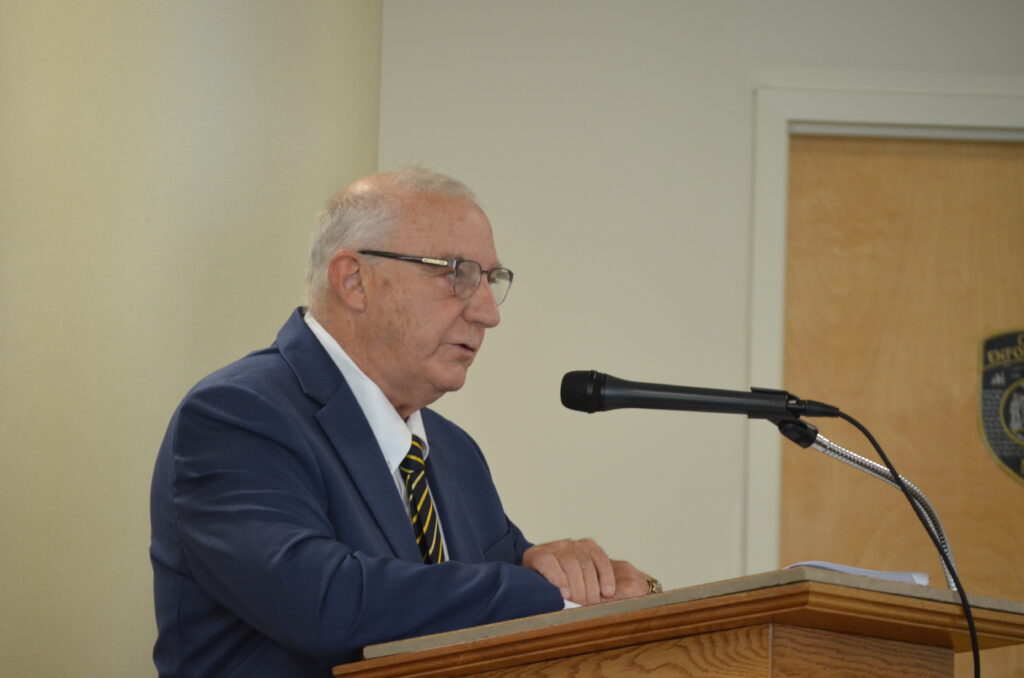
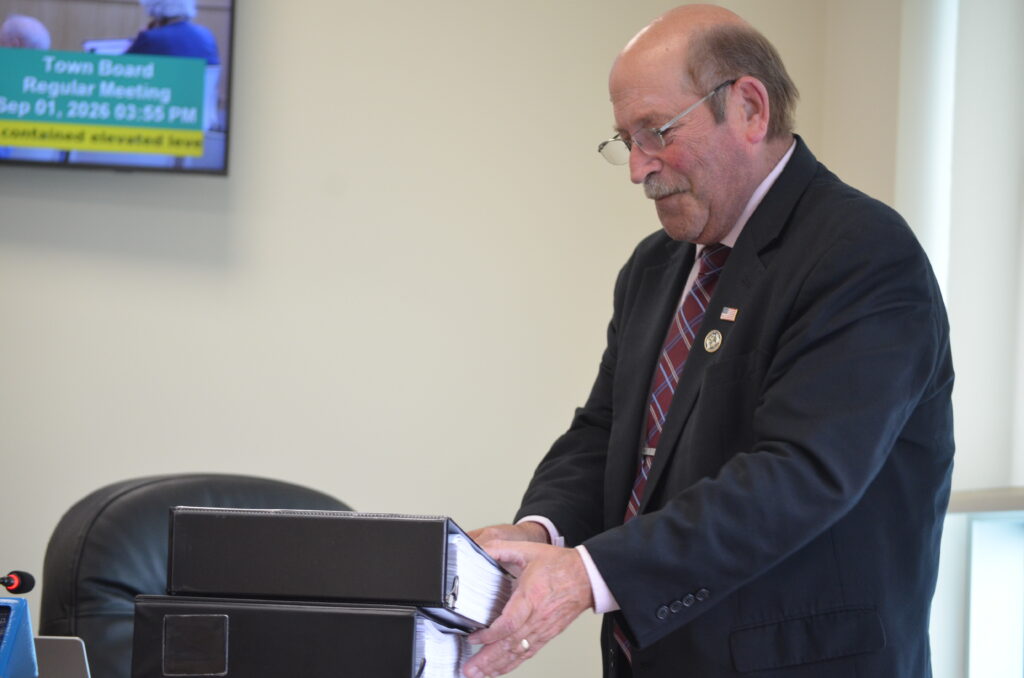
Brody Smith, the attorney representing the SCWA at Riverhead’s Monroe hearing, presented town clerk Jim Wooten with two filled binders of the authority’s findings for the record. He defended the authority’s pipeline route revision, stating the DEIS shows thorough analysis and compliance with environmental law.
“From a legal point of view, the State Environmental Quality Review Act requires any agency engaging in an action to engage in a meaningful study — to take a hard look about what the potential impacts of a proposed plan would be,” Mr. Smith said.
He said the Main Road route was chosen for engineering and public health reasons, not cost, and the regional benefits of the transmission line outweigh the localized, mostly short‑term construction impacts.
Stan Carey, a Baiting Hollow resident who has worked for both the Riverhead Water District and Suffolk County Water Authority, as well as served as a former Riverhead Planning Board Chairman, said in his 40 years in the public water supply industry he has not seen this level of controversy over a water main project.
He conceded that SCWA “could do a better job of working with the town”, but argued the town needs to look at the big picture.
“This is nothing new,” Mr. Carey said. “The scrutiny has never been done before, it’s a case of do as I say, not as I’ve done — it’s really unfair, this is a benefit to the residents of the North Fork.”