Riverhead residents fume over 160% tax spike tied to Friar’s Head lawsuit
Riverhead homeowners opening their tax bills may feel like they’ve been hit by an errant golf ball — a sharp spike landing with little forewarning this year.
That increase — roughly 160% in the chargeback portion of tax bills — stems from a court-ordered refund tied to the town’s long-running legal battle with Friar’s Head Golf Club, a case that is now costing taxpayers millions.
The sharp increase is the direct result of Riverhead Town paying $6 million in court-ordered refunds to the luxury Sound Avenue golf course. In total, the town will have to cough up $7.2 million in required tax refunds overall through property owners’ tax bills this year.
For a typical homeowner, that jump can mean hundreds — and in some cases thousands — of dollars added to their annual tax bill, depending on the value of the property.
Many residents have been fuming at the sticker shock after seeing the added charge, first reported by Newsday.
“I am disappointed that this Town Board didn’t mention one word that there was a settlement, and that the enormous, gigantic, stupendous increase in our taxes was coming forth,” Claudette Bianco of Baiting Hollow said at the board’s April 9 meeting.
In a letter to the editor published in the April 23 Riverhead News-Review, Ms. Bianco compared the dispute to being taxed for something that doesn’t exist.
“Imagine you were taxed for a pool because you have a large backyard and could put in a pool but haven’t?” she wrote.
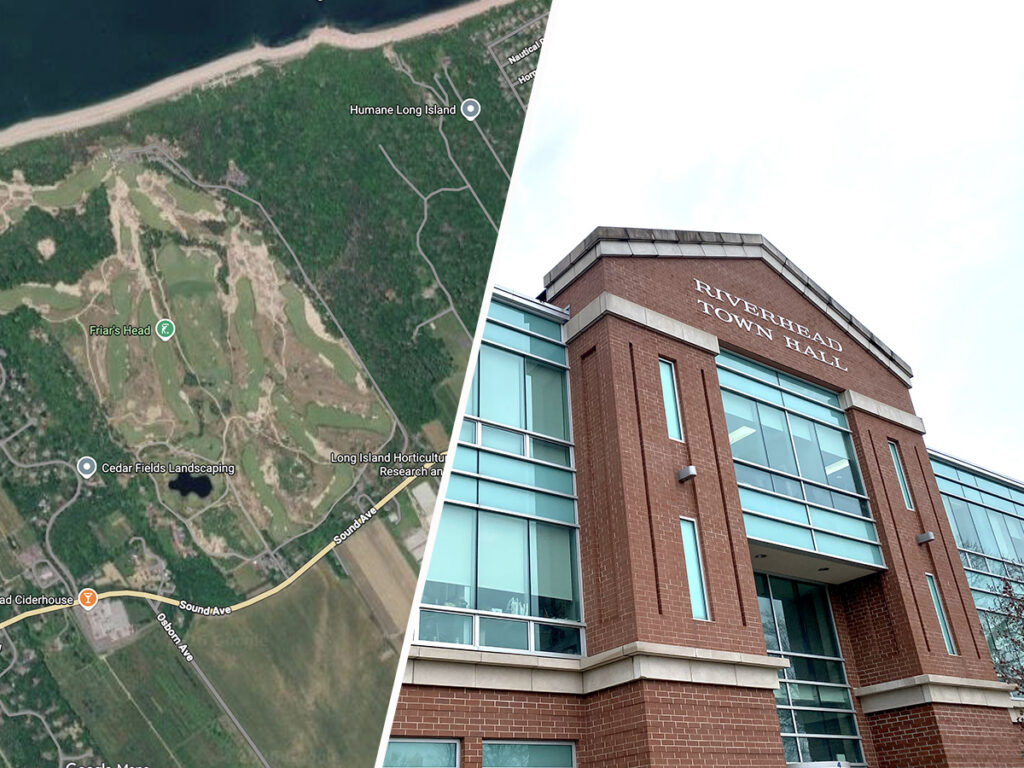
The dispute dates back nearly two decades, when Traditional Links LLC — the owner of Friar’s Head — challenged the town’s assessment of its 350-acre Sound Avenue property.
At the center of the case was how the town valued roughly 85 acres of undeveloped land. Assessors factored in the potential for future development, increasing the overall valuation — an approach the golf course owner successfully argued overstated the property’s worth.
A state Supreme Court judge sided with Friar’s Head in 2019 and ordered refunds. After years of appeals, that decision was upheld in 2024, setting the stage for the current impact.
| Tax Year | NYS RPTL Debt Line |
|---|---|
| 2014-2015 | $776,278 |
| 2015-2016 | $498,515 |
| 2016-2017 | $437,352 |
| 2017-2018 | $390,498 |
| 2018-2019 | $2.2 million |
| 2019-2020 | $413,282 |
| 2020-2021 | $2.1 million |
| 2021-2022 | $3.2 million |
| 2022-2023 | $3.9 million |
| 2023-2024 | $1.9 million |
| 2024-2025 | $2.7 million |
| 2025-2026 | $7.2 million |
Public records from the town tax receiver’s office show the New York State Real Property Tax Law debt line has fluctuated significantly over the last decade (see chart above).
Town officials say the shift is driven by court rulings and state law, not local discretion.
“It’s nothing we can control, and we are not responsible for the chargeback dollars,” assessor Laverne Tennenberg told the Riverhead News-Review last Monday. “It’s the amount we’re charged — what we’re responsible for is valuing it.”
The roughly 160% jump applies uniformly, though higher-valued properties shoulder a larger share while lower-valued homes pay less.
Roughly 830 separate tax grievances have been filed against Riverhead Town from last year alone, the assessor said. These lawsuits come from all different types of property owners, ranging from commercial and industrial to residential, who want to challenge their assessed value in court.
Each case carries the potential for additional refunds that would be passed back to taxpayers in the same way.
“Next year, I don’t know what it’s going to be,” Ms. Tennenberg said. “We still have outstanding years, plus, we have all the other litigation that we deal with on a daily basis.”
The last time Riverhead conducted a townwide reassessment was 1980, a factor officials say makes valuations more difficult to defend as market conditions shift.
While not all cases have merit, the assessor said the town still has to spend time and money defending every one.
“Pick a dart, throw it anywhere on the tax map, guarantee they’re filing a lawsuit,” Ms. Tennenberg said.
What happened with Friar’s Head?
With the total acreage in mind and the belief that potential development could occur on the extra parcels, Riverhead Town’s board of assessors at the time determined the fair market value of the property at between $28.3 million and $34 million, according to court documents.
The golf course owner argued the real estate tax assessment should be less, and challenged the town’s determination in court. Friar’s Head presented an appraisal report, which suggested the market value of the property as a single lot fell between $9.2 million and $10.7 million.
The court concluded in 2019 that the property value should range between $10 million and $11.6 million.
“It would be unfair to tax a property for a value that it does not have,” the judge wrote.
Traditional Links has other tax certiorari cases still pending.
Not a unique situation
Ms. Tennenberg and other town officials argued there were several issues with the court’s decision. By valuing a high-end private golf course as if it were a daily-fee course, like Cherry Creek in Aquebogue, the court uses an income capitalization methodology that severely undervalues the property, the assessor explained.
The Tuckahoe School District sued Southampton Town nearly 10 years ago in a similar scenario, Ms. Tennenberg said. When faced with $6 million in revenue losses in a three-year span, the school district suspected it was because local golf courses paid significantly lower taxes.
“At what point do you cut your losses, and just have to take it on the chin?” Ms. Tennenberg said. “It’s unfortunate, but it’s not unique to just Riverhead.”
As residents put blame on the town assessors’ office, Town Board officials are coming to its defense.
“I think that our assessors do a phenomenal job, and that what happened with the tax assessment was deemed that way by a court,” Councilwoman Joann Waski said at the April 21 Town board meeting. “I think that the assessor at the time had the best interest of the town and the taxpayer to be able to assess the property, that we all know is worth a lot of money, and it’s unfortunate that the taxpayers of Riverhead lost on that.”