Riverhead Town Board roundup: RVAC lease advances, parking limits approved and legal fees questioned

Plans for the Riverhead Volunteer Ambulance Corps’ new headquarters cleared two major hurdles.
The Riverhead Town Board on Tuesday approved a long-term lease agreement for RVAC’s proposed headquarters on Osborn Avenue and scheduled a public hearing on whether the project should be exempt from town zoning requirements.
The agreement begins with a 25-year lease and includes five possible 10-year renewals, potentially allowing RVAC to occupy the property for 75 years. It is subject to a permissive referendum, meaning residents can petition to bring the Town Board’s decision to a public vote.
The board also scheduled a public hearing for Tuesday, Aug. 4, to determine whether the emergency-services project should be exempt from town zoning and land-use regulations under the state’s Monroe balancing test.
RVAC plans to demolish its existing one-story headquarters and construct a three-story, 25,303-square-foot facility with offices, meeting rooms, fitness and recreation areas, a kitchen, bathrooms, bunkrooms and a one-story garage for emergency vehicles.
Councilman Ken Rothwell, the Town Board liaison to RVAC, said the height required for the ambulance bays made a three-story headquarters the most cost-effective option.
“This building will essentially exceed the height by a very small amount and it may also exceed the square footage, but it is what’s necessary for RVAC to have the ability to have a training area and so forth,” Mr. Rothwell said.
He said officials hope to close the Aug. 4 hearing, grant the necessary approvals and allow RVAC to begin construction by Sept. 1.
RVAC currently has raised $6.4 million through fundraising events and the generosity of private donors to cover the cost of the bond and interest, the councilman said. The remaining balance would be paid through ambulance-service fees collected primarily from insurance carriers, leaving no burden on town taxpayers, he added.
The total cost for the project could be up to $9 million or less, depending on how much RVAC raises, the Riverhead News-Review previously reported. The lease agreement states if RVAC does not raise enough money in private funds to cover the entire cost of the project, the town can issue a bond for whatever money is needed.
“This is a project that is, at this point, not being built with taxpayers’ funds, which is pretty incredible for us,” Mr. Rothwell said. “To move a project of this magnitude, to build an entire new facility, to finally bring them into the current day and age without taxpayers’ dollars.”
RVAC president Garrett Lake thanked town officials for their support.
“This is a big project that we’re embarking on,” Mr. Lake said. “Your commitment to this project doesn’t go unnoticed and the entire membership of RVAC appreciates it.”
The RVAC project was one of several issues the Town Board tackled Tuesday. Here’s what else happened at the July 21 meeting:
- Parking ban and downtown restrictions put in place: To improve visibility and reduce dangerous conditions, the Town Board banned parking near the intersection of Sound and Twomey avenues in Baiting Hollow. Officials also approved a two-hour limit for the 30-space parking lot behind Moonfish Brewery and the municipal lot east of the Salvation Army near Turkuaz Grill, extending from East Main Street toward McDermott Avenue. Councilwoman Denise Merrifield and Mr. Rothwell said the limits would provide immediate relief to downtown businesses by increasing parking turnover.
- Public hearing set on amendment to town’s pet store law: Public hearing set on changes to town’s pet-store law: The Town Board scheduled an Aug. 4 public hearing on proposed amendments to Riverhead’s prohibition on the retail sale of dogs, cats and rabbits. The changes are intended to bring the town code in line with New York State’s Puppy Mill Pipeline Law. The proposal includes revised operating-hour and record-keeping requirements, allows the town to pursue civil action against violators and provides refunds under certain circumstances when violations occur.
- New recreation chief appointed: Ashley Schandel was officially appointed the new superintendent of Riverhead’s Parks and Recreation Department. Read the full story here.
- Site-plan review procedure amended: The Town Board eliminated the preliminary site-plan approval step, converting the current two-step review process into one. The adopted law also removes certain land-use application fees from the town code, allowing the board to establish them by resolution. Community development administrator Dawn Thomas said the changes would simplify the review process without reducing opportunities for public input.
- Sewer District capital project budget approved for Peconic River Hotel: J. Petrocelli Development Associates paid the Riverhead Sewer District $8,800 for the preparation of a map and plans to connect the Peconic River Hotel to the town sewer district.
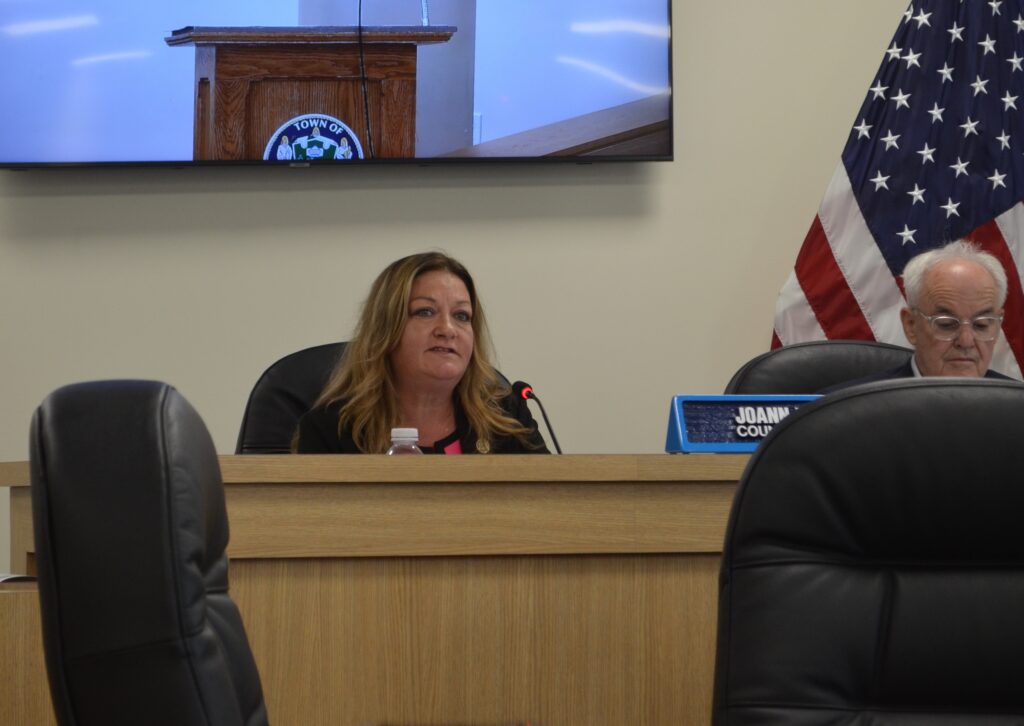
- Comments on OLA legislation: The topic of OLA Eastern Long Island’s proposed public safety legislation took hold of the public comment portion of the meeting. Councilwoman Joann Waski cleared the air on a vague comment she made in the social media comment section of a RiverheadLocal story regarding her position on immigration enforcement. She said she opposes OLA’s public safety proposal:
- “We need to take care of our local, legal residents, those that are trying to become legalized, to be a U.S. citizen, that is important to many of us,” Ms. Waski said. “I know that there are people on both sides that are afraid…I’ve run into people, even in the Latino community, that say they are scared, and they are here legally, they’re afraid for their families. There’s been fear put out there that a lot of them are not feeling, and we have to have a balance.”
- Criticism over costly legal fees in even-year election law litigation: Multiple community members questioned the town’s reasoning for pulling out of the federal lawsuit challenging New York’s Even-Year Election Law and if the town plans to recover its $275,000 in legal fees. Town attorney Erik Howard said the town entered the multi-party litigation because officials felt the law encroached on the town’s home rule power. Ultimately, after further discussions with outside counsel, Mr. Howard made the “strategic” decision to exit the lawsuit. When asked if the town will attempt to reclaim the money, Mr. Howard said an effort would probably not be made as the town would likely lose.
- CDA matters following Town Board meeting: The Community Development Agency approved a $95,000 fund balance transfer for additional legal fees needed to the town’s EPCAL lawsuit against Triple Five.
The next Riverhead Town Board meeting is set for Tuesday, Aug. 4, at 2 p.m.