Revised SCWA pipeline route faces criticism from Riverhead residents
Despite its pipeline detour, Riverhead residents remain reluctant to go with the flow of the Suffolk County Water Authority’s rerouting to Main Road — citing concerns with how construction could disturb traffic, local schools and area wetlands in Aquebogue.
At SCWA’s final public hearing on Wednesday where officials went over the expectations for the revised project, town officials and community members questioned what benefit does Riverhead get in return for being the host of possible infrastructure, traffic, and environmental risks during the pipeline’s construction on Main Road.
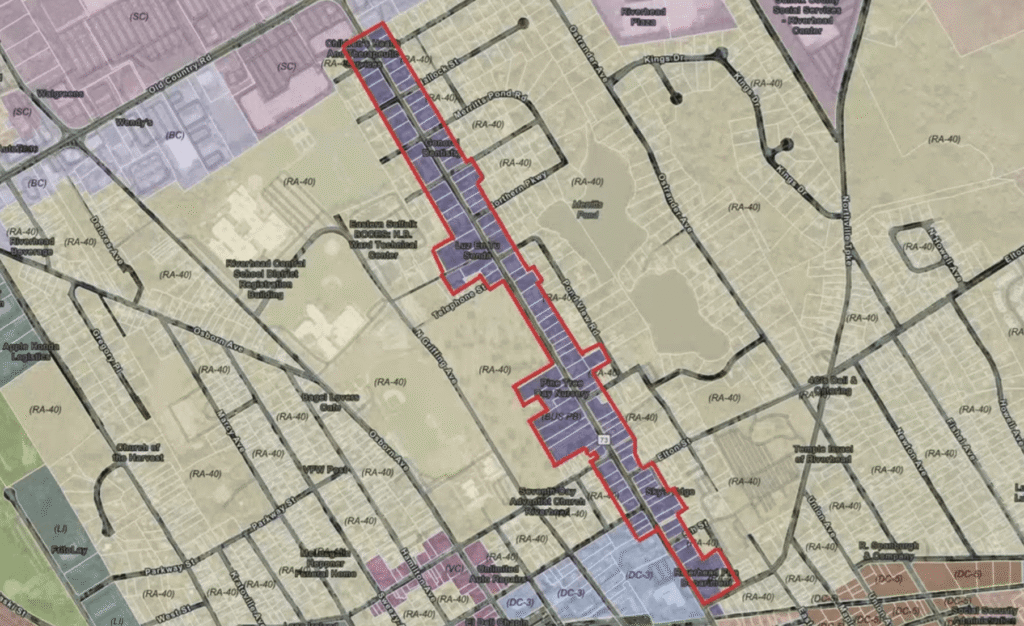
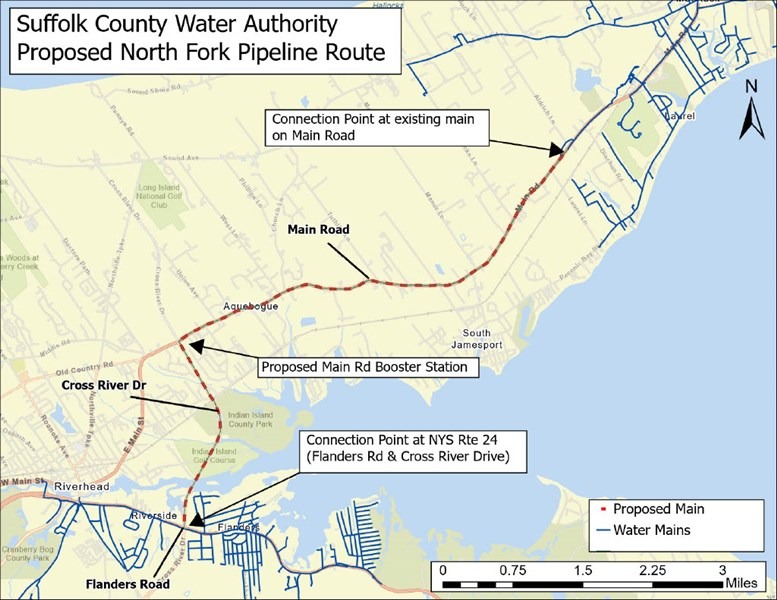
In response to comments collected during several public scoping sessions held last year, the SCWA announced its new plan last month to send the 7.5-mile transmission line north along County Route 105 and then east beneath Main Road/State Route 25, moving it away from Sound Avenue.
“I’m happy about your commitment to conservation, and if I lived in Southold, I’d probably be thrilled, but I don’t,” said Kathleen Courtney, an Aquebogue resident who lives off of West Lane.”I know you have to break a few eggshells to make an omelet, but can there please be another way to do this? You’re going to wreck a community.”
The new “preferred” Main Road route is one mile shorter, moves anticipated completion up from 2030 to 2028 and still bypasses the Riverhead Water District, with no connections planned within its service area. It will also now cost somewhere between $22 and $25 million total — about $10 million less in construction costs than the original $35 million pipeline project price tag.
This is a fully budgeted project and will be integrated into the SCWA’s existing annual $100 million capital improvement budget. However, the authority says it intends on applying for a grant.
SCWA plans to construct a booster station at “an undeveloped sparsely vegetated” property the agency owns at the intersection of Cross River Drive and Main Road in Aqueboue, rather than the previously proposed location at the intersection of Sound and Pier avenues, according to the Draft Environmental Impact Statement prepared by Nelson, Pope & Voorhis, LLC.
The water main would then be directionally drilled under Main Road from south to north and continue east along the north side of Main Road to a point near the intersection of Franklinville Road and Main Road in Laurel, where it will connect to an existing 16-inch SCWA water main.
When analyzing the proposed Sound Avenue route and the third Peconic Avenue alternative, Main Road became the “preferred” route in the DEIS due to its hydraulic benefits. Its low elevation eliminates the need for a second booster, officials said, and allows for a shorter route that reduces excessive water aging in the main.
Construction on the narrow Sound Avenue corridor would also be avoided, SCWA officials explained, which mitigates traffic and safety concerns expressed previously.
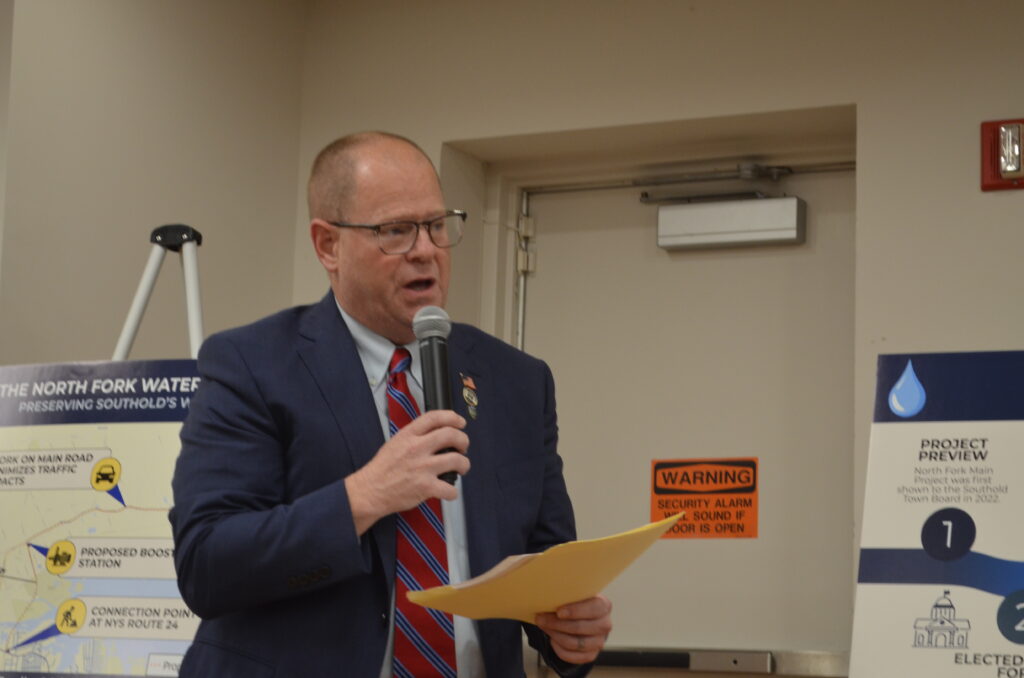
“This is feedback that we heard from folks who made public comments: stay off Sound Avenue, it’s narrow, it’s historic, we can’t have a water main project disrupting commerce and the folks up there,” SCWA CEO Jeff Szabo said. “We heard you, we understand your concerns, and we agree that we think the state road is a much better way to go.”
In consideration for the community and homeowners directly affected by the roadwork, the idea is to implement numerous mitigation measures to keep construction “rolling” and avoid significant traffic delays or road shutdowns.
This includes installing the water main at a rate of 300 to 600 feet per day, creating an installation schedule that avoids traffic interruptions during the busy fall and summer seasons, coordinating daily with Main Road landowners, temporarily blacktopping trenches and fully repaving the affected roadway once the project is completed.
However, a majority of local residents and town officials at the final SCWA public hearing were still not convinced.
“This change of plan was not a case of ‘we’ve heard you,’ it’s more like ‘Oakdale, we have a problem,’” said Barbara Blass of Jamesport. “The Main Road route is now the preferred action, and while both Sound Avenue and Main Road share some of the same impacts, shifting the road changes impact intensity and shifts the location of the impacts to a different setting.”
Ms. Blass continued to outline the pieces SCWA is missing, such as a traffic and school safety analysis, specifically how the construction could affect daily school bus activity for Aquebogue Elementary School. She said SCWA must recognize Riverhead’s local wetland jurisdiction and seek the proper town permits where work falls within those areas.
“As the lead agency and project sponsor, the authority cannot hide behind a cloak of Monroe immunity and ignore potential impacts to portions of existing wetlands because they are within the jurisdiction of a local municipality,” she said.
Suffolk County Legislator Greg Doroski piggybacked on Ms. Blass’ wetlands jurisdiction point, highlighting the $2.2 million Meetinghouse Creek wetlands and habitat restoration effort currently underway. He asked if SCWA would commit to any added protections to this area.
“Suffolk County Water Authority is already treating Riverhead’s wetlands authority as notification only, rather than seeking a town permit,” the legislator said. “It is particularly sensitive in that the plants will just be getting reestablished, and any disruption in the area could be negative.”
Riverhead Town remains firm in its belief the SCWA should not be exempt from its zoning and land-use regulations.
Although the route revision would narrow the scope of approvals needed from Riverhead, town officials would still require a special permit for the proposed booster station in the Rural Corridor zoning use district, along with building permits, variances and other services for the structure.
Additionally, the overall “substantial construction” within Riverhead could potentially require road opening permits and easements, as well as review by the town’s Conservation Advisory Council.
SCWA’s attempt to sidestep the towns’ approval processes with claims of zoning “immunity” is a major point of contention. With both parties in active litigation, some speakers argued SCWA’s repeated statements “indisputably” immunity are “premature” and “speculative.”
Councilman Ken Rothwell claimed there was no quorum of the SCWA board of directors present during the agency’s Monroe Balancing Test hearings back in October, yet a resolution finding SCWA immune from local land-use rules was adopted by the board.
“Any official decisions, votes, or formal proceedings undertaken without a quorum are legally invalid,” Mr. Rothwell said. “Based on observations and research, the SCWA Monroe Test appears to be a severely flawed process and therefore not legally binding.”
Riverhead Town Supervisor Jerry Halpin chimed in, saying the SCWA’s repetitive claims is a “self-declared immunity.” He went on to ask more about the traffic implications on Main Road, possible disruptions to daily school activities, how construction could impact snow plowing, the Meetinghouse Creek project and overall public safety.
“I understand, as ‘up Islanders,’ you may think that there’s still an off season, but there is no off season to Riverhead because we are a fully functioning, year-round, explosive town that is doing great things,” Mr. Halpin said. “We ask again that you not impede the business or the confidings of our town — we ask that you work with us to bring clean water to the East End.”
The town’s environmental consultant Jeffery Seeman mainly criticized the missing traffic analysis that he claims SCWA promised to include in the DEIS. Continuing another one of Mr. Halpin’s points, the DEIS states the Sound Avenue route is still viable, even though Main Road is noted as the most “viable.” This means the SCWA will decide its route selection once a finding statement is prepared.
“I think it would be to everyone’s advantage at this point to make a decision as to which route you’re going to take, so the impacts can be more clearly evaluated and the mitigation put together in a stronger way,” Mr. Seeman said. “I certainly agree, you’re going to have difficulty reaching a findings statement until all litigation is finalized — you placed Monroe as a key topic in the environmental impact statement, and in order for you to get to a true finding statement, you’ll have to address that issue.”
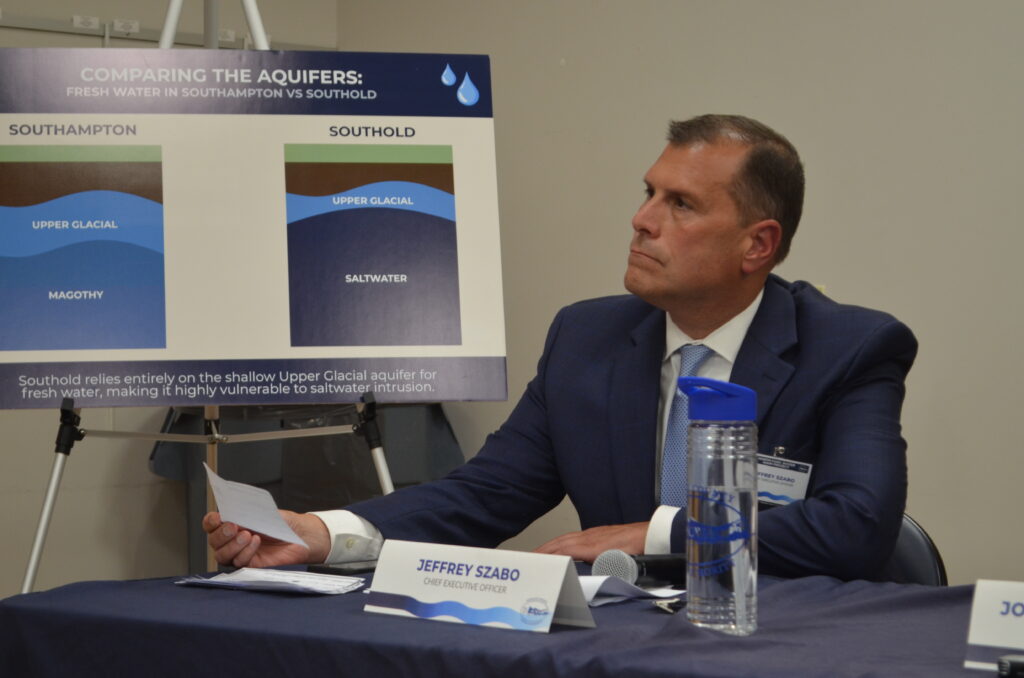
Suffolk County Water Authority officials continued to defend its water pipeline project on the North Fork, arguing the project is needed to address growing demand, saltwater intrusion and dwindling emergency water reserves.
“We have a lot of water, there’s not doubt about it,” Mr. Szabo said. “That doesn’t mean that we, this generation of folks, can just abuse it..the problem is getting worse, and it’ll never be enough — we need a long-term solution to provide adequate water to Southold, and we’ve come up with it.”
The public comment period on the Draft Environmental Impact Statement is extended until Friday, Sept. 25 at 5 p.m. Submit comments at www.scwa.com/nfp/.
Riverhead Town plans to have another Monroe Balancing Test hearing for the revised North Fork pipeline project on Tuesday, Sept. 1 at 2 p.m.