SCWA reroutes controversial North Fork pipeline, blindsiding local leaders
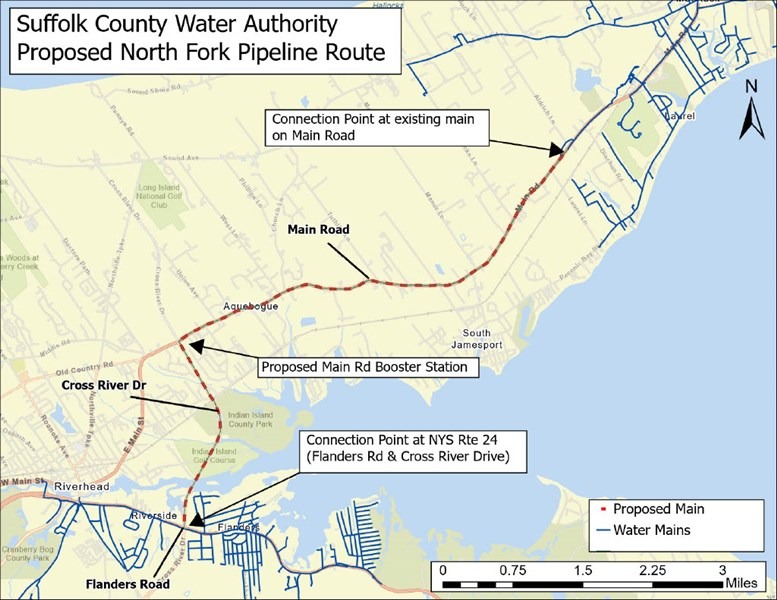
The controversial North Fork pipeline got a surprise twist in the road Friday as the Suffolk County Water Authority unveiled a substantially revised route — a sharp turn that blindsided Riverhead and Southold leaders in the process.
The new plan sends the 7.5-mile transmission line north along County Route 105 and then east beneath Main Road/State Route 25, moving it away from Sound Avenue. The route is one mile shorter, moves anticipated completion up from 2030 to 2028 and still bypasses the Riverhead Water District, with no connections planned within its service area.
Neither Riverhead Supervisor Jerry Halpin nor Southold Supervisor Al Krupski received advance notice of the revisions, according to the two town leaders.
SCWA said it revised the route in response to comments collected during several public scoping sessions held last year. The authority said the overall water-main route is now one mile shorter than originally proposed.
“We listened to the public during our 2025 scoping sessions and designed a plan that reflects their input,” SCWA CEO Jeff Szabo said. “This new route allows us to execute the project swiftly while keeping community impacts to an absolute minimum.”
Dan Dubois, SCWA’s communications director, confirmed on Wednesday the revised routes slashes the estimated total cost for the pipeline project from $35 million to $25 million.
“We are reviewing the new proposed route and its associated impacts to our taxpayers,” Mr. Halpin said in a statement late Friday.
He said the new route addresses some, “albeit not all,” of Riverhead’s previous environmental concerns and that the town would conduct its own review as an involved agency under the New York State Environmental Quality Review Act.
Town Attorney Erik Howard later called the rerouting a positive development because it moves the pipeline off a town road.
“Route 25/Main Road is wider, and traffic patterns can likely be planned out for more effective travel along that road,” Mr. Howard told the News-Review on Monday.
The change would narrow the scope of approvals needed from Riverhead, he said. SCWA would still require a special permit for the proposed booster station in the Rural Corridor zoning use district, along with a building permit for the structure.
Mr. Howard said the town and its special counsel are reviewing the new plan and draft environmental impact statement in connection with the pending lawsuit. He said Riverhead’s position under the Monroe balancing test — which determines whether a public authority is exempt from local zoning and land-use regulations — “would remain consistent.”
SCWA sued Riverhead in February after the Town Board voted unanimously on Oct. 7, 2025, to find that the authority was not exempt from those regulations. SCWA has asked a judge to annul the town’s findings and prevent Riverhead from enforcing its zoning and land-use laws against the project.
Mr. Krupski said Southold’s concerns about the pipeline remain despite the change. He confirmed that the town still plans to conduct its own Monroe balancing test to determine whether SCWA should be exempt from local zoning and land-use regulations.
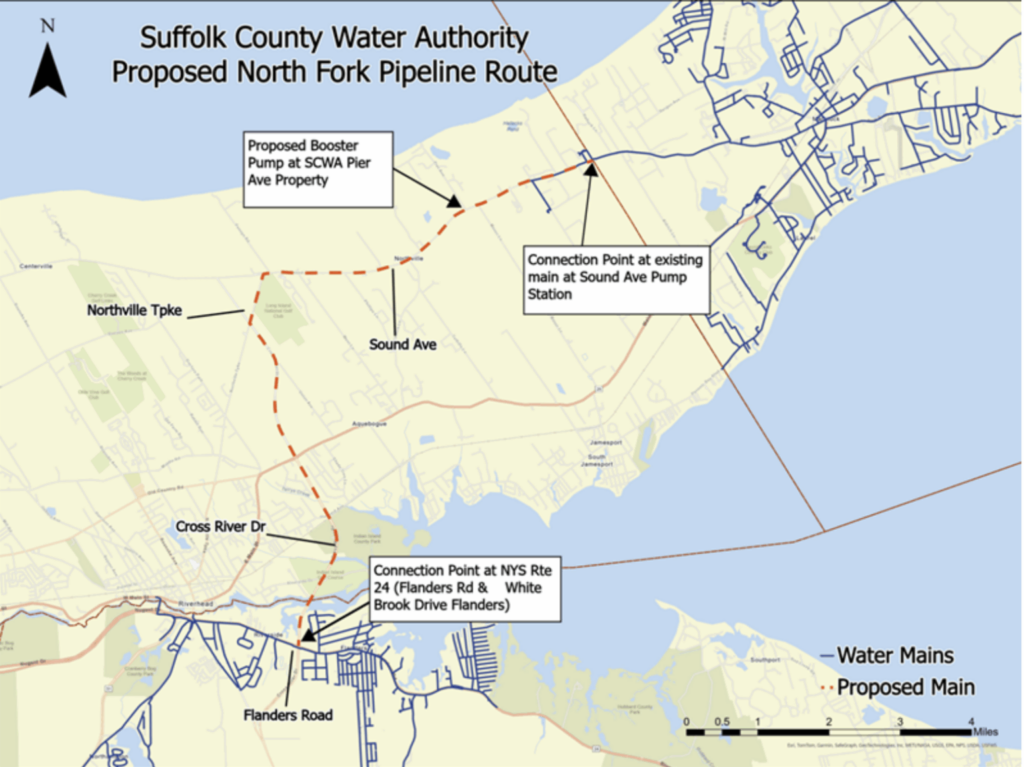
“What impact, obviously, the route itself and the impact to traffic and businesses along the route, the disruption during construction, no matter which route it is, and then the same concerns about where the water is coming from, is there enough water, where’s the water going to,” Mr. Krupski told the Riverhead News-Review on Friday. “Conservation efforts here, the actual cost of developing a well field, the actual cost of a pipeline, all those concerns are still the same.”
The original plan called for an 8.5-mile, 24-inch transmission line running from Flanders to the Southold Town line. It included a booster station near the intersection of Sound and Pier avenues.
The revised plan calls for a 7.5-mile transmission line of the same size. It eliminates the proposed Sound Avenue booster station, although the project still includes a new booster station near Main Road and Cross River Drive to stabilize water pressure and improve reliability.
According to SCWA, the new route will reduce environmental and traffic impacts and allow the authority to complete the project roughly two years earlier than anticipated.
Brendan Warner, SCWA’s director of construction maintenance, said construction is expected to take 12 months once the authority obtains all necessary permits.
“We will stage the work specifically to avoid traffic disruptions on the North Fork during the peak summer and fall months,” Mr. Warner said.
SCWA maintains that the pipeline is necessary to preserve water pressure and reliability on the North Fork, particularly during the summer, when irrigation demand peaks.
The authority also contends that bringing water from elsewhere in its system would reduce the daily pumping burden on local wells, allowing the Upper Glacial Aquifer to recover and helping prevent saltwater intrusion. SCWA said the additional supply could also reduce the need for specialized treatment systems at existing wellheads.
“This project is a requirement for the long-term sustainability of the North Fork,” SCWA Chairman Charlie Lefkowitz said in Friday’s press release. “It protects our local water resources while ensuring we meet the current needs of our communities. This project is a win for the environment, it protects future ratepayers and ensures that we have a sustainable supply of high-quality drinking water for the North Fork.”
SCWA sued Riverhead Town in February to advance the pipeline project. The Riverhead Town Board voted unanimously on Oct. 7, 2025, to adopt its own Monroe Balancing Test findings, concluding that SCWA was not exempt from local zoning and land-use regulations.
Riverhead has argued that the pipeline would bypass its zoning laws and provide no direct benefit to town water district customers.
SCWA reached the opposite conclusion in its own Monroe findings, contending that it is “indisputably immune from local municipal jurisdiction,” according to court records. The authority asked a judge to annul Riverhead’s determination and prohibit the town from enforcing its zoning or land-use laws against the project.
Riverhead Town hired an outside law firm in March to assist with the case. They are in communication with this special counsel on how these changes may impact pending litigation.
SCWA will present the revised plan and accept public comments at three hearings next month:
- Wednesday, Aug. 19, at 6 p.m. at SCWA’s facility, 624 Old Riverhead Road, Westhampton Beach.
- Thursday, Aug. 20, at 5 p.m. at the Southold Town Recreation Center, 970 Peconic Lane, Peconic.
- Wednesday, Aug. 26, at 4:30 p.m. at the Riverhead Public Library, 330 Court St.
The draft environmental impact statement is available on SCWA’s website. The authority will accept written comments through Sept. 11 at scwa.com/nfp.