Riverhead, SCWA clash over zoning control of proposed $35M pipeline
The Suffolk County Water Authority once again said it doesn’t need Riverhead’s approval to build an eight-mile pipeline through town — a claim local officials are calling an overreach that could set up a legal showdown over zoning authority.
At a public hearing Thursday, Oct. 9, at the Riverhead Free Library, SCWA officials presented their findings under the Monroe Balancing Test, concluding the agency has immunity from local regulation because it serves as a regional public entity. Two days earlier, the Riverhead Town Board voted unanimously to adopt its own Monroe Test results, reaching the opposite conclusion.
The dueling decisions have left the two sides deadlocked over who has final say on the estimated $35 million project, which would carry water from Flanders through Riverhead to supply customers in Southold.
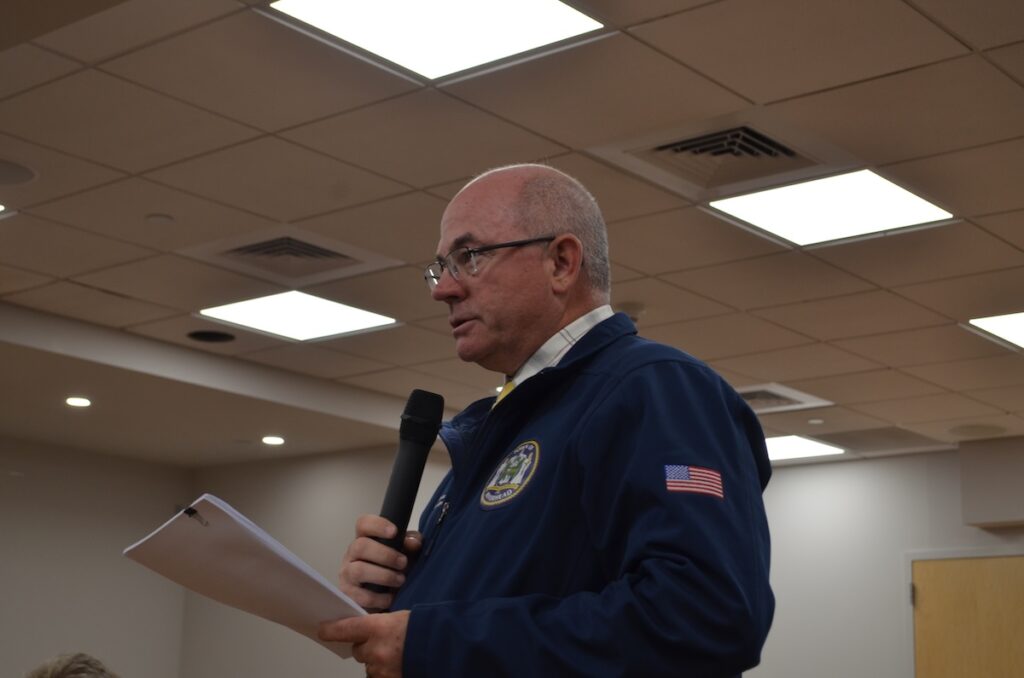
“This project is indisputably for the benefit of the people of Suffolk County and the state of New York,” said Richard Finkel, attorney for SCWA, reiterating the claim he made at two previous meetings held in Westhampton and Peconic last week. “If we had to abide by the zoning laws of 43 different municipalities, it would be impossible for us to operate.”
Town officials, however, insist Riverhead, as the host community, has the right to determine how and where construction proceeds.
The proposed pipeline would run 8.15 miles from Flanders through Riverhead, supplying about 9,500 Southold customers whose existing wells are nearing capacity. SCWA says the project is critical to maintain water pressure and reliability on the North Fork, especially during summer months when irrigation demand peaks.
Mr. Finkel said the authority’s immunity claim rests on the principle that it performs “an essential governmental function.” The SCWA operates across 10 towns and nearly three dozen villages, he noted, and could not function if each municipality imposed its own zoning conditions.
“This would be untenable,” he said. “The authority’s purpose is to provide drinking water countywide — that’s a matter of public health and welfare.”
Mr. Finkel stressed the construction of the underground pipeline would cause temporary impacts on roadways, but all affected roads would be fully restored. In consideration of the community, Mr. Finkel said the SCWA will avoid road closings and traffic interruptions during the busy fall season.
He added the SCWA is “fully aware and capable” of managing construction so there is minimal damage. Mr. Finkel referenced the previous installation of 7,000 feet of water main in Riverhead and the current 20,000-foot water main extension project happening in Manorville.
Town officials say they aren’t disputing the project’s need but how it’s being handled. Riverhead leaders argue that as the “host community,” they’re entitled to review impacts on traffic, roadways, and neighborhoods within town borders — and to require compliance with local zoning codes.
Councilwoman Denise Merrifield criticized SCWA’s draft environmental documents as “void of key studies,” including traffic and infrastructure impacts. “This project does not benefit any residents in the town of Riverhead.”
Riverhead Town officials have disputed SCWA’s attempt to “circumvent” Riverhead’s authority to conduct its own Monroe Balancing Test by suggesting the agency’s test findings will be included in its draft environmental impact statement.
The Monroe Balancing Test — named for a 1988 New York Court of Appeals case — is used to decide whether one level of government can bypass another’s zoning authority. It weighs nine factors, some of which include the project’s public benefit, environmental impact and whether local oversight would hinder regional goals.
Both Riverhead and SCWA conducted their own tests and reached opposite conclusions. The town’s findings from its test in August, presented by Mr. Rothwell on Thursday after being reaffirmed two days earlier, determined that SCWA should comply with local regulations as a matter of fairness and community accountability.
Southold officials, meanwhile, have questioned whether SCWA has overstated the extent of the water crisis. The town passed irrigation legislation in July and has an ongoing U.S. Geological Survey study on the aquifer.
Joan Cear, recording secretary of the Greater Jamesport Civic Association, urged SCWA officials to consider relocating the pipeline underneath the electric transmission line easements that run from Riverhead to Mattituck, in order to avoid disruption to major roadways like Sound Avenue.
At Thursday’s hearing, residents urged both sides to work together before the conflict escalates.
“We’re headed for an impasse,” said Barbara Blass, a former Riverhead Town Board member. “I don’t think residents want to stop this project, but they also won’t stand by while construction moves forward without accountability.”
Erik Howard, town attorney, said the Riverhead Town Board were advised of its legal options in a recent executive session and the various ways potential litigation could play out. However, no decision to commence litigation has been made.
“The Town Board is prepared to seek judicial intervention if it becomes apparent that such intervention is necessary to protect the best interests of the Town and our residents,” Mr. Howard wrote in an email.
SCWA has received more than 100 comments on the project through public hearings, including one in Westhampton on Monday, Oct. 6, and another the next day in Peconic. The authority will release its final project scope in the coming weeks, publish a draft environmental statement before the end of the year and complete its final environmental impact statement by early 2026.
The open comment period for residents to share input on the SCWA arguing immunity from local zoning laws ends on Wednesday, Oct. 15, at 5 p.m. Public comments can be submitted at scwa.com/nfp.