New testing shows higher contamination levels in Grumman plume, officials say

The U.S. Navy’s 30-year neglect of the toxic Grumman plume in Calverton poses a serious threat to local waters and public health, and Suffolk County says the cleanup deadline is long overdue.
After a heated Restoration Advisory Board meeting back in February, local officials unveiled independent county testing of private wells before a packed crowd at the Manorville firehouse last Tuesday — data the Navy declined to accept — as concerns grow over the spreading groundwater contamination moving beneath Calverton from the former Grumman site.
The county’s extensive split sampling and “full suite” testing of Navy wells showed alarmingly high concentrations of perfluoroalkyl and polyfluoroalkyl substances (PFAS), volatile organic compounds (VOCs) — specifically chlorinated solvents trichloroethane (TCA) and trichloroethene (TCE) — and 1,4-dioxane in various areas in and around the ex-Grumman site.
These contaminant levels were significantly higher than what the Navy previously released to the public.
“They forgot to clean up the mess they left,” Suffolk County Executive Ed Romaine told the crowd. “They left a gift that will keep on giving in the wrong way for many years.”
Other troubling findings showed substantial amounts of PFAS in the Peconic River and Swan Pond. Both water bodies are popular boating and fishing spots, and health officials stressed that the past surveys show a credible risk of people eating contaminated fish.
What distressed those at last Tuesday’s meeting was the fact that the Navy collected fish, sediment and surface water samples form Swan Pond in November 2024, detected excessive concentrations of these “forever chemicals” in the fillets — and did not notify anyone for a year.
“We are not without resources, and we are prepared to do what we need to do to protect our residents,” Mr. Romaine said. “We either see movement or we’re going to exercise whatever options we have, and we have options as a local, municipal government.”
Numbers exceed drinking water standards
During his hour-long presentation, Andrew Rapiejko, a hydrologist for Suffolk County Department of Health Services and a Calverton RAB member, walked the audience through the Navy’s remediation efforts over the last three decades and how the county’s data compares.
The source of the contamination has been traced to aqueous film-forming foam, a firefighting foam regularly use when military aircraft were being built and tested there. The foam contains toxic chemicals including PFAS that have been linked to cancer, liver damage, fertility problems and asthma. The Navy first identified the presence of PFAS in the area’s groundwater in 2016.
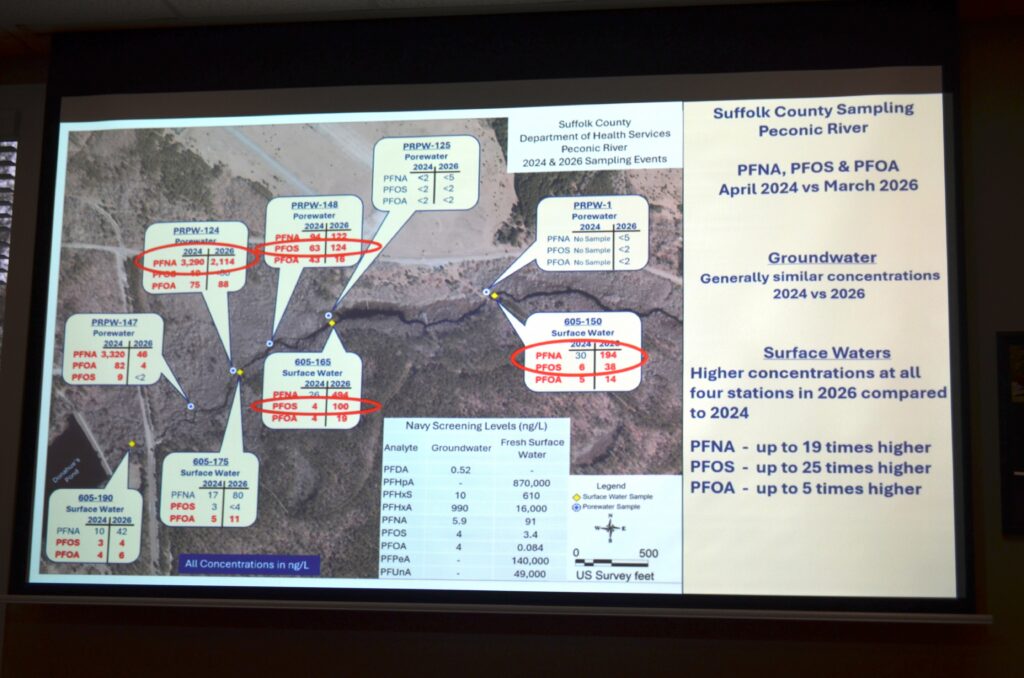
More recently, Suffolk County health department performed independent PFAS sampling of the Peconic River, first in 2024 and then again this year. The results showed sharp spikes in perfluorononanoic acid (PFNA), perfluorooctanesulfonic acid (PFOS) and perfluorooctanoic acid (PFOA) concentrations within the two-year period.
Mr. Rapiejko said the county health department detected 25 times more PFOS in the Peconic River; the PFNA concentrations were 19 times higher than in 2024, and PFOA levels were five times higher.
At one well, the PFOS concentration jumped from 4 parts per trillion in 2024 to 100 this year. Some levels were in the thousands. The New York State drinking water standard for PFAS is 10 ng/L.
Concerns about fish consumption
The Navy collected fish, sediment and surface water samples in 2024, which showed PFOS concentrations ranging between 14 and 61 parts per billion. The New York State Health Department has established fish consumption guidelines for this particular chemical.
Citing these guidelines, Mr. Rapiejko said if it is less than 10 parts per billion, a person shouldn’t eat more than four meals per month, from any single water body in New York. If the concentration is above 10 and below 40, the fish should not be consumed more than once a month. If it’s above 40, people should avoid eating the fish entirely.
A 2004 CREEL survey documents a substantial number of people eating fish from the Peconic River, particularly minority communities, and the Navy is aware of this survey, Mr. Rapiejko added.
“You don’t get the risk unless you’re exposed to it, so you can catch the fish and if it’s contaminated, you throw it back, there’s no risk to you … the way to get exposed to contamination is to eat it,” the hydrologist said. “Nothing has changed, it’s not gotten less, in fact, people are more reliant on the river.”
The county’s recommendations to the Navy
The Calverton RAB and county health department made several recommendations for the Navy moving forward. One is to install groundwater treatment systems to prevent additional PFAS and 1,4-dioxane contamination from entering the Peconic River.
Given the significant contamination in Swan Pond and the Peconic River, county officials said further PFAS testing is needed on the fish as well. The state health department is reviewing data and plans to issue a fish consumption advisory for Peconic Lake in the near future. The Suffolk County Health Department has placed a “no fishing” sign at Swan Pond.
Local officials also requested that the Navy investigate the former fire training area and tire burn site, and evaluate any potential future PFAS impacts to Riverhead Water District’s plant No. 7.
Many officials slammed the Navy’s CERCLA process — the Comprehensive Environmental Response, Compensation, and Liability Act, or “Superfund” — used to remediate PFAS, VOCs and other contaminants at the former Grumman site.
The Navy uses this method to test emerging chemicals individually, rather than sampling at the same time. County and town representatives feel the Navy should perform annual groundwater testing for all contaminants of concern to better understand and address their spread.
“I think the county is doing their part, it seems like the state is jumping in … my reading of the CERCLA requirements [is] I think the state can do a little bit more to require broader testing from the Navy,” Suffolk County Legislator Greg Doroski said. “But, what can the public do to pressure the Navy here to clean up their mess?”

Remediation is possible, health officials say
In 2011, the Navy installed a pump-and-treat system in response to very high VOC levels along the fence that separates the Grumman property from Riverhead Road, and farther south at the Peconic Sportsman’s Club. With almost 100% of the groundwater plume at the Bethpage Grumman site under active control, officials said the Navy should follow the same model in Calverton.
Although PFAS — or forever chemicals — are highly mobile in groundwater, advocates say removal is possible with carbon treatment systems. Given roughly 50 years of PFAS use and groundwater moving at about one foot per day, the contamination could span roughly three miles from the Grumman site.
“This is not rocket science,” said Adrienne Esposito, executive director of Citizens Campaign for the Environment. “This can be doable, but they have to want to do it, but we can no longer wait for them to act.”
The Navy issued a press release last Wednesday responding to Suffolk County’s findings and concerns. A consultant was the sole Navy representative at the Tuesday meeting, and only identified herself when Mr. Romaine asked if any Navy officials were in attendance.
“The Navy has been evaluating historical PFAS releases at former NWIRP Calverton since 2016 and prioritized efforts to identify and address PFAS in drinking water,” the statement read. “The Navy has completed several rounds of private well sampling, as thresholds have developed, to sample drinking water wells for PFAS in the direction of groundwater flow away from the former Grumman facility.”
Need for public outrage
Sherri Guthrie’s home at Peconic Lake Estates connects to public water. However, with a looming PFAS plume just west of her neighborhood not yet connected, she worries what direction it is taking. She believes more pressure needs to be placed on the Navy.
“There should be more testing, extensive testing to see where this plume is going — to me, it looks like it is still heading east,” Ms. Guthrie said. “I understand the water authority can’t find a connection right now, but I still feel I would like to see more testing done … there are pieces there, but we need to connect the dots.”
Mark Fehner of Long Island Kayak Bass Fishing feared a potential shut down of fishing in the Peconic River and Swan Pond could impact his operations, given the decreasing number of available spots. He also questioned the amount of fish consumption in these waters.
“We’re losing bodies of water every year,” Mr. Fehner said. “Now you just took two more lakes from us — everyone is going to pound the hell out of those [other] lakes, and it’s going to destroy the ecosystem and the fishery of the population.”
Many RAB members in attendance, including Councilman Bob Kern and Kelly McClinchy, encouraged residents to bring their concerns to the next RAB meeting in June.
“A lot of people that might be in this room now have public water access to their home … that was just the beginning,” Ms. McClinchy said. “It’s important to remember: We think we have gone over this hurdle; we’re not there yet.”
Anyone who is interested in private well testing can schedule an appointment with the Suffolk County health department at 631-852-5810. The service is free to homeowners living in the survey area. Anyone outside of those boundaries typically pays a $100 fee.