Riverhead Town Board roundup: Winery owners and farmers criticize private party law

Winery owner Charles Massoud and other representatives of Riverhead’s farming industry took aim at a circulating private parties bill that they believe targets the town’s agricultural businesses and vineyards.
The private events law proposal, which Riverhead town officials discussed at a July 23 work session, establishes a comprehensive regulatory framework for recurring “assembly-type private events,” such as weddings, birthdays, galas, corporate functions and other events intended for private entertainment or commercial event hosting.
However, Mr. Massoud argued the bill treats wineries “as if we’re all out there trying to create problems for the town.”
“If you really think you have a problem with the wineries, bring us in, let’s have a conversation,” said Mr. Massoud, owner of Paumanouk Vineyards and Palmer Vineyards. “Let’s understand what is the problem you’re trying to fix and let’s see if we can come up with a solution that’s good for everybody…this is unbelievable, you’re living in another world.”
According to the law’s summary, the legislation addresses the town’s regulatory gaps with a fair, predictable permitting process and objective enforcement standards to ensure these assembly-type events are conducted responsibly. It intends to protect public health and safety by evaluating and addressing impacts such as traffic, parking, noise, lighting, emergency access and neighborhood compatibility.
Officials say there are a number of exemptions in the law, including qualifying agritourism activities, and it is not intended to regulate ordinary residential activities or interfere with normal agricultural production and state law protections for farmers.
Venues looking to host recurring private events would submit one annual application for a permit to host multiple private events throughout the year. It also establishes a general annual event cap of eight events per calendar year, or up to 12 events if they apply for a waiver. The permit fee would be determined by the Riverhead Town Board.
Wineries and vineyards may be exempt from the annual event limit and exceed the cap if they can provide evidence that proves the property’s principal use remains a bona fide agricultural production or marketing as a winery or vineyard.
This credible documentation includes revenue, production volume, retail sales, or other operational indicators demonstrating that event activity is secondary to the agricultural function of the property, according to the law proposal.
Mr. Massoud questioned the town’s need to look at the wineries’ “finances.”
“I’ve been doing this for 43 years now, we are a good neighbor, we have no problem with traffic, we obey the laws, we are a good public citizen,” the vineyard operator said. “Our business is down, as you know, wine consumption is down, instead of the town helping us do better, you’re trying to crucify us.”
Bill Zalakar, executive director of the Long Island Farm Bureau, said nearly 70% of agricultural income in Suffolk County goes back into the local community, through farms, tourism, restaurants and more.
“Riverhead has always been known as the epicenter of agriculture on Long Island and of all of New York State, such heritage that this town and community has,” Mr. Zalakar said. “The big question is, does a town want to keep agriculture?”

Matthew Pendleton, a local farmer and member of the town’s Agricultural Advisory Committee, urged the town to leave agriculture out of the proposed code.
The possibility of a restrictive private events code could threaten the long-term viability of agriculture by making it difficult to run events that support farm revenue and undermine a sector that drives local economic activity and tourism in Riverhead.
“There are few easier ways for the town to generate economic opportunity other than placing additional burden on the backs of the farmers — this type of narrative is concerning to our farmers beyond the proposed code,” Mr. Pendleton said. “It highlights a profound disconnect between the town’s perception of agriculture and our community, and the actual reality of the situations facing the farmers.”
Several other issues were addressed during the August 18 meeting, here is what you missed:
Public hearing on changes to Riverhead’s Business PB (BUS PB) Zoning Use District
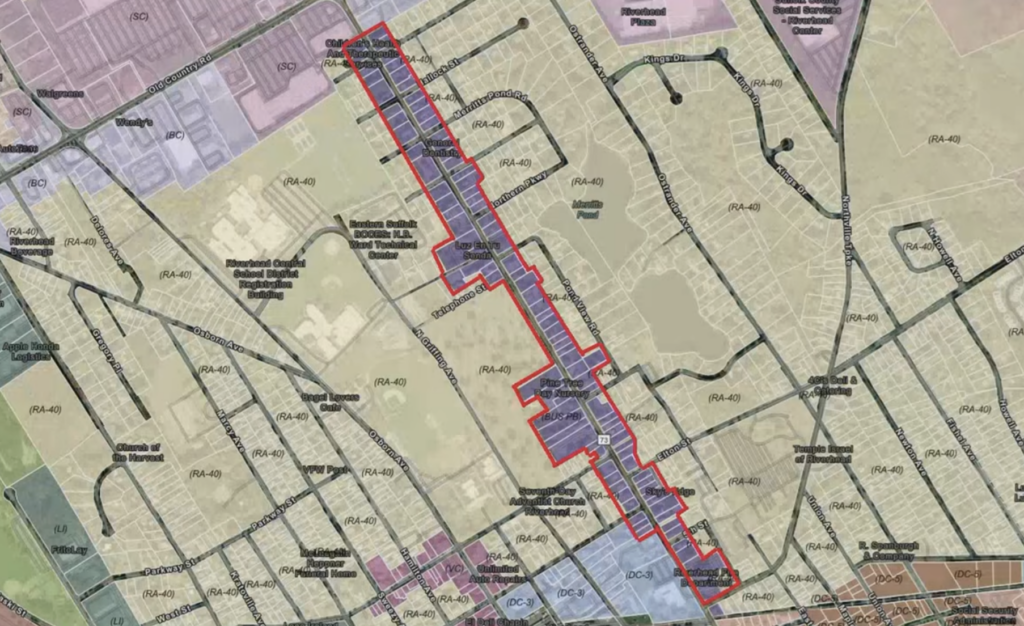
Senior planner Greg Bergman outlined the proposed amendments to the town’s Business PB (BUS PB) Zoning Use District, which is located on Roanoke Avenue, beginning just north of the intersection with Northville Turnpike and extends just south of the traffic circle at Old Country Road. The changes to the permitted uses within the zoning use district would allow personal services as a permitted use, apartments on upper floors, and limit hours of commercial business operation.
Mr. Bergman said a hair‑treatment studio application triggered a closer look at what’s allowed in the Business PB district. When he reviewed the code through the lens of “impacts,” he concluded that personal‑service uses like this are generally low‑impact, as they don’t generate heavy traffic, involve outdoor activity or storage that would harm nearby homes.
Riverhead Town Assessor Laverne Tenneberg voiced her opposition for the code change to accommodate personal services businesses, arguing it would be a “detriment to adjacent residential property owners” and other homes in close proximity.
With Roanoke properties already struggling with on-site parking, she warned tenant parking from permitted upper-floor apartments would further create insufficient parking and cause overflow onto side streets, as well as in front of peoples’ homes.
“Why would this board add uses currently not permitted in the zone when a business owner has a plethora of opportunities to locate their business in a zone where it is permitted,” Ms. Tenneberg asked. “Why are we contorting ourselves to accommodate one person’s request at the expense of many others?”
Councilwoman Joann Waski explained her reasoning for considering the zoning code revisions, saying the idea was to avoid building vacancies by allowing low-impact personal services to occupy already-commercial Roanoke properties as office tenants leave.
“It’s not specifically to one particular person,” the councilwoman said. “It was opening up the uses for other things that could possibly go in the buildings that have already been converted from residential into a commercial business.”
Public written comment is open for the next 10 days and closes on Aug. 28.
Tax litigation lawsuit settlement

Riverhead Town agreed in court on Aug. 18 to reduce United Riverhead Terminal’s assessments by $6.66 million for tax years 2020/21 through 2026/27, according to court documents. The settlement cost in this long-running tax litigation between URT and the town’s board of assessors had not yet been disclosed by the town board at the Tuesday meeting. However, Councilman Kenneth Rothwell said he has received a number of concerns from residents about how the settlement will impact their tax bill, which has yet to be determined. He said the town board is looking into how they can work with Suffolk County to extend the payment schedule so that “it is not a one-time hit,” like what happened with Friar’s Head.
OLA dominates public comments

All dressed in black clothing, a steady stream of nearly 20 Latino rights advocates, religious leaders, educators and concerned residents approached the podium in support of the highly debated legislation, which aims to install an “emergency preparedness” plan if another ICE raid happens on the East End. Read the full story here.
Monroe Balancing Test hearing scheduled
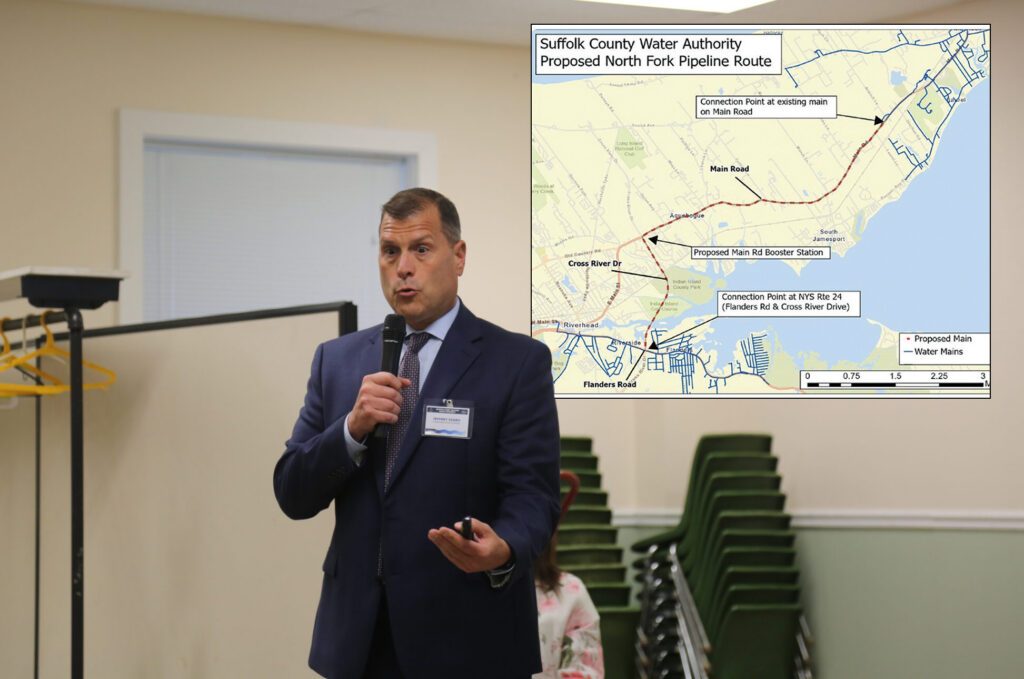
The Riverhead Town Board set a date on Tuesday evening for another public hearing on Sept. 1 to determine if the Suffolk County Water Authority’s revised pipeline route is exempt from local zoning and land use laws under the state’s Monroe Balancing Test.