Schumer warns Pentagon delayed key Calverton PFAS investigation by more than a decade
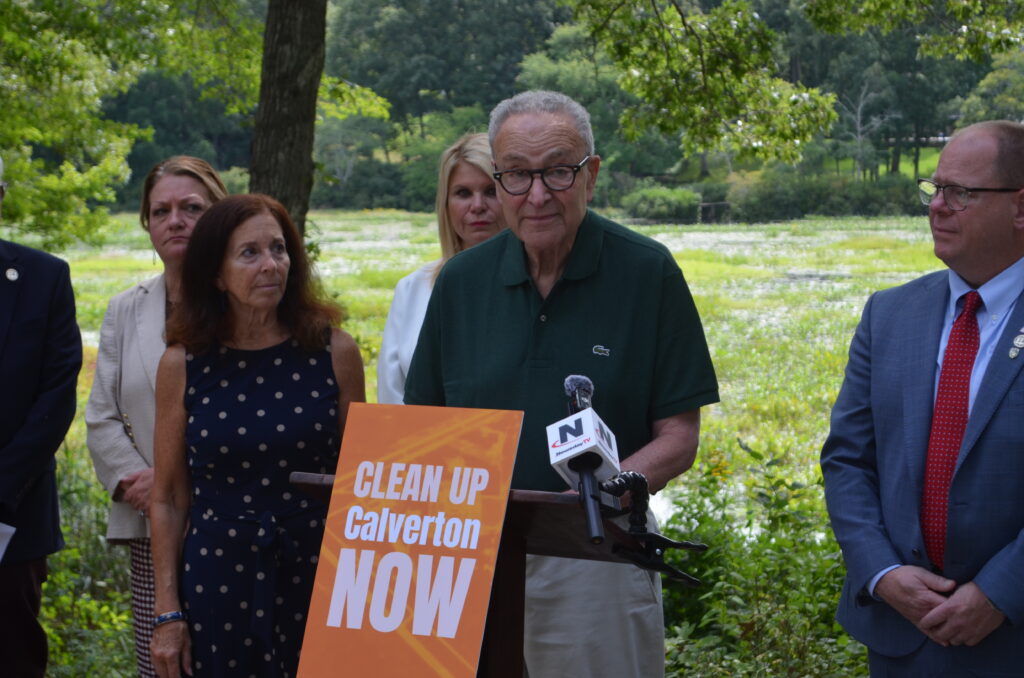
The Pentagon has pushed a key PFAS investigation at the former Grumman site back more than a decade, Sen. Chuck Schumer warned Thursday during a stop in Calverton.
Department of Defense records cited by the Democratic Minority Leader show the projected completion of the Navy’s Remedial Investigation/Feasibility Study at EPCAL has slipped to April 2039. This information came as a shock, as it was not clearly disclosed to the public, according to officials and those putting pressure on the Navy to clean up Calverton.
Contamination cleanup schedules at 727 military sites across the country have been delayed nearly a 1,000 times since 2021, according to Department of Defense records cited by Mr. Schumer at Peconic River Herb Farm.
Additionally, reports show more than 200 installations were deferred for a third time in a single year.
The Navy lists the Enterprise Park at Calverton’s Remedial Investigation/Feasibility Study as “underway.” The process is designed to determine how far contamination has spread, assess the risks and evaluate potential cleanup options, and may not be completed until 2039.
With concerns mounting over the spreading groundwater contamination beneath Calverton and toward the Peconic River, Mr. Schumer joined local officials and environmental advocates in demanding a remediation plan before the plume spreads farther.
The New York senator laid out several demands for the Navy: accept Suffolk County’s testing data, install additional monitoring wells, expand testing for other PFAS compounds and 1,4-dioxane, improve coordination with local officials and develop a remediation plan to stop the plume.
“Long Island has already too many forever chemicals,” Mr. Schumer said. “We do not need, do not want, and will not accept a forever cleanup.”
The Naval Weapons Industrial Reserve Plant was established in 1954 as a government-owned facility operated by Grumman to develop, assemble and test Navy combat jets. The facility was also used for paint shops, machine shops and degreasing and storage of oil and chemicals.
The former Grumman site was used for building and testing military aircraft until 1996, when the company left Calverton. Since then, groundwater pollution at the site has been attributed to the decades of aircraft production. The Navy first identified the presence of perfluoroalkyl and polyfluoroalkyl substances, or PFAS, in the area’s groundwater in 2016.
The source of the contamination has been traced to aqueous film-forming foam, a firefighting foam that was in regular use when military aircraft were being built and tested there. The foam contains toxic chemicals including PFAS that have been linked to cancer, liver damage, fertility problems and asthma.
The demands from town, county, state and now federal officials are in light of recent independent private well testing data from the Suffolk County Health Department.
The county’s findings showed high contaminant levels in and around the former Grumman site at EPCAL – significantly higher than what the Navy previously released to the public. Many readings exceeded state drinking water standards.
Mr. Schumer said the Navy has disputed the county’s findings and called on it to accept the local testing data.
“The Navy needs to accept those findings and not dispute them,” Mr. Schumer said. “We need to know whether this plume has already moved beyond the Navy’s current scope — we don’t know that yet. You cannot stop what you refuse to measure.”
Those at a public meeting this spring were distressed to learn that the Navy collected fish, sediment and surface water samples from Swan Pond in November 2024, detected excessive concentrations of the “forever chemicals” in fish fillets — and did not notify local officials for about a year.
Concern intensified at a public meeting this spring after residents learned the Navy collected fish, sediment and surface water samples from Swan Pond in November 2024, detected excessive concentrations of these “forever chemicals” in the fillets — and did not notify anyone for a year.
“That is unacceptable,” Mr. Schumer said. “Going forward, the Navy must coordinate with local officials on all testing plans and share results the moment they come in.”
Adrienne Esposito, executive director of Citizens Campaign for the Environment, questioned how the Navy has spent $78 million so far on the EPCAL cleanup.
“How is that possible when they’ve cleaned up almost none of it,” Ms. Esposito said. “It should have, with that amount of money, been cleaned up years ago.”
She said the Calverton Restoration Advisory Board has asked the Navy to install an extraction well at the leading edge of the PFAS plume coming from the former firefighting training area, or burn pit, on the property.
The solution proposed by the Navy is to cut off the plume migration pathway by installing an underground funnel and gate system.
“Instead of using a tried and true solution, they are doing a pilot program,” she said. “That makes no sense to us.”
She further stressed the ongoing plea from the Calverton RAB that the Navy should be testing for all contaminants at the same time, not individually.
Riverhead Town Supervisor Jerry Halpin spoke about how the growing plume could affect the welfare of the general public and Riverhead’s ongoing revitalization efforts.
“This problem is not just a Calverton problem – we all know the data, we know that Suffolk County is doing their part, but if this plume continues will have devastating effects on what myself, and my fellow board members, who stand here together unified, have been working so hard on: our restoring of downtown Riverhead,” Mr. Halpin said. “We need the Navy to clean up now.”
Although the issue has reached a “crescendo,” Mr. Schumer stressed that the Navy and federal government must bear responsibility, while acknowledging that steps are being taken.
Ron Martz, a local resident affected by the EPCAL plume, asked why Northrop Grumman is not being held accountable.
“Navy’s got the biggest pot of money, but we’ll go after everybody,” Mr. Schumer responded.