Navy outlines steps being taken to curb delays in Grumman PFAS cleanup

The Navy says they are not going to wait until 2039 to handle the cleanup of the growing toxic plume in Calverton.
Earlier this month, Sen. Chuck Schumer paid a visit to Riverhead to warn residents and local elected officials of a more than decade-long delay in the Pentagon’s investigation of PFAS at the former Grumman site.
Department of Defense records cited by the Democratic Minority Leader show the projected completion of the Navy’s Remedial Investigation/Feasibility Study at EPCAL — the second phase of the overall cleanup — has slipped to April 2039. This information came as a shock, as it was not clearly disclosed to the public, according to officials and those putting pressure on the Navy to clean up Calverton.
Contamination cleanup schedules at over 700 military sites across the country have been delayed nearly a 1,000 times since 2021. According to a report in USA Today, the PFAS cleanup timeline for Calverton has been delayed at least six times in the five years.
Riverhead Town Councilman Bob Kern asked the Navy to address this news report and the 10-year stall at the recent Calverton Restoration Advisory Board meeting last Wednesday.
Bob Fisher, environmental restoration branch head for Naval Facilities Engineering Systems Command (NAVFAC),was present at the meeting to give clarity on what this delay to 2039 means for the seven PFAS sites on the EPCAL property currently in the remedial investigation phase.
He explained those dates do not mean cleanup must wait until 2039. Navy officials may proceed with earlier response actions as warranted.
“We definitely have money budgeted to address concerns at this site this year, next year, and every year up into 2039,” Mr. Fisher said. “I think they’re kind of blending different concepts there — the idea is that phase two, the remedial investigation phase, when that ends, that would typically then trigger the next phase of the cleanup… we’re not going to wait until 2039 to do cleanups, those are going to be programmed in along the way as needed.”
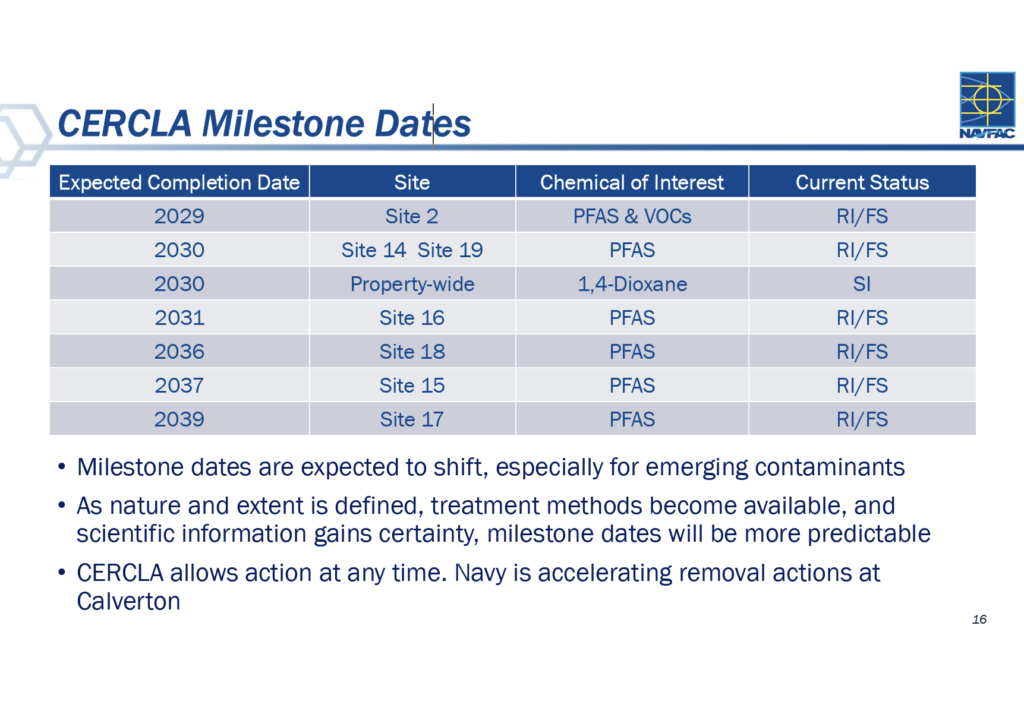
Brian Revell, environmental engineer for the Navy, stressed the projected end dates for each of the seven sites are “anticipated,” but may be “accelerated” with developing technologies, regulatory requirements and additional resources becoming available.
Three particular identified PFAS areas were of focus during the RAB meeting: Site 2, Site 14, and Site 19.
Site 2 refers to a former fire training area where firefighting foam was used during training exercises to extinguish fires. Navy officials said they are moving forward with its pump-and-treat response, which targets higher PFAS concentrations downgradient.
At the end of July, a Navy-owned treatment system was moved from Willow Grove, Pennsylvania and installed in Calverton. Two extractions wells were drilled in areas close to Site 2 in August where the PFAS concentrations were suitable enough in order to result in high removal of the forever chemicals.
Now in full operation this month, Savannah Wolfe, a project manager and federal Navy program PFAS lead for Resolution Consultants, said groundwater travels through roughly 900 feet of piping to treatment vessels using granular activated carbon and ion-exchange media.
Going forward, the Navy will monitor the system’s performance, test treatment media, and add foam fractionation to tackle PFAS streams. Over the course of several months of pumping, monitoring data will be collected to help determine whether a funnel-and-gate system is needed.
RAB members were given a tour recently of the Site 2 system by the Navy, which helped them see the system in operation and ask detailed questions about how it works.
Ongoing PFAS investigations are happening at Sites 14 and 19. Sampling found PFAS — especially perfluorononanoic acid, or PFNA — at greater depths than expected, prompting changes to the monitoring-well plan, according to Nate Winston, geologist and project manager of the two sites for Resolution Consultants.
Additionally, to assess any potential impacts from these two sites, further extensive sampling of fish tissue, surface water and sediment in the Peconic River is expected to begin in November. Mr. Winston said the hope is to be able to have this data validated by winter 2027.
This follows an intense public meeting this spring where residents learned the Navy collected fish, sediment and surface water samples from Swan Pond in November 2024, detected excessive concentrations of these “forever chemicals” in the fillets — and did not notify anyone for a year.
Andrew Rapiejko, a hydrologist for Suffolk County Department of Health Services and RAB member, asked if the Navy’s fish sampling data were to show significant elevated concentrations of PFAS that could impact human health, would it speed up the remediation process of sites 14 and 19, instead of waiting until 2030 to address those areas.
Navy officials responded saying if the fish data does show high PFAS levels, that data could trigger more immediate internal actions, such as implementing a new treatment system at the two sites.
Many pointed out the urgent need to halt the spread of the plume from the Peconic River to the Peconic Bay, as it poses ecological risks.
Former Congressman George Hochbrueckner, who pushed for the Peconic Bay to be included in the National Estuary Program in the early 1990s, urged the Navy to determine how far PFAS has migrated and act quickly to prevent further impacts to the bay.
“We cannot let PFAS head to the bay,” Mr. Hochbrueckner said. “How soon do you think you could determine where that plume is and stop it from getting to the Peconic Bay ASAP, and get some extraction wells in place to stop that?”
Others pressed the Navy on whether monitoring wells were positioned to capture the plume, noting that these proposed locations might not align with the highest concentrations of PFAS.
Riverhead Water District Superintendent Frank Mancini asked for more information on and the need for sentinel wells near two public supply well sites within the water district. He also wondered if the U.S. Geological Survey is getting involved in field support and groundwater-flow modeling.
Mr. Fisher confirmed the Navy is coordinating with the USGS and acknowledged how there has been collaboration before on other sites, such as Bethpage.
Piggy-backing off of Mr. Mancini’s comments, Mr. Kern felt there had been a “reluctance” from the Navy to work with the USGS in the past.
“The suspicion is that they would unearth things that would cause the Navy to have to really put up more funding,” the councilman said. “I’m really glad to hear that that’s going to happen, but I can understand that they can unearth things to what Frank is talking about a lot quicker, and really, why the Navy wouldn’t take any assistance to fight this war is beyond me.”
There is still pressure on the Navy to accept Suffolk County’s independent testing data of private wells, which revealed contaminant levels significantly higher than what the Navy previously released to the public.
Mr. Rapiejko said the county is compiling new data from wells placed near approximately 80 existing Navy wells to bypass previous sampling constraints. The New York State Department of Environmental Conservation is also collaborating with Suffolk County to collect and analyze fish from the Peconic River near Sites 14 and 19.
All of this data is in the process of being compiled and reviewed, and the county plans to hold another forum in the near future to discuss these findings.
“It’ll give a bigger, complete picture,” the county health official said.