Riverhead Charter School’s five-year renewal bid draws strong opposition
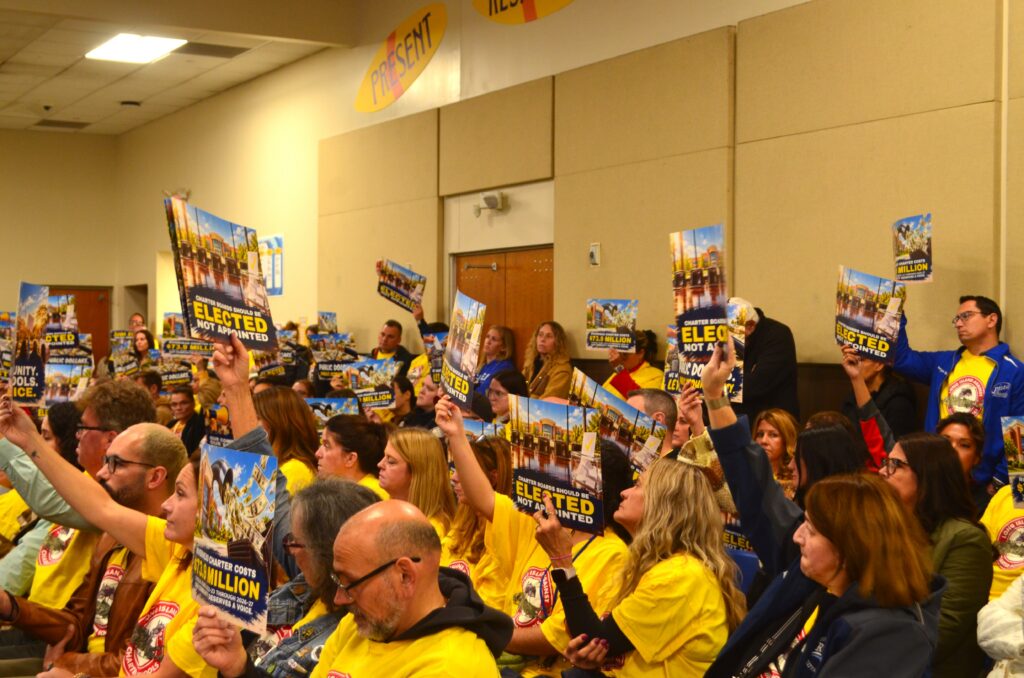
Riverhead Charter School’s bid for another five-year term met strong opposition at a packed public hearing Wednesday night.
Educators, parents and elected officials crowded into Riverhead Middle School to question the charter school’s financial impact on district classrooms, services for students with disabilities and accountability to local taxpayers.
Before entering the hearing — held by the Riverhead Central School District — the group Long Island Against Charter Schools led a rally outside the middle school. Teachers from Brentwood, Lindenhurst, Wyandanch, Deer Park, Shoreham-Wading River and Bayport-Blue Point school districts attended in solidarity with one unified message: “public dollars belong in public schools.”
Riverhead Charter School’s current charter, which began in July 2022, is valid through June 30, 2027. The school serves kindergarten through 12th grade, with a projected enrollment of 1,244 students.
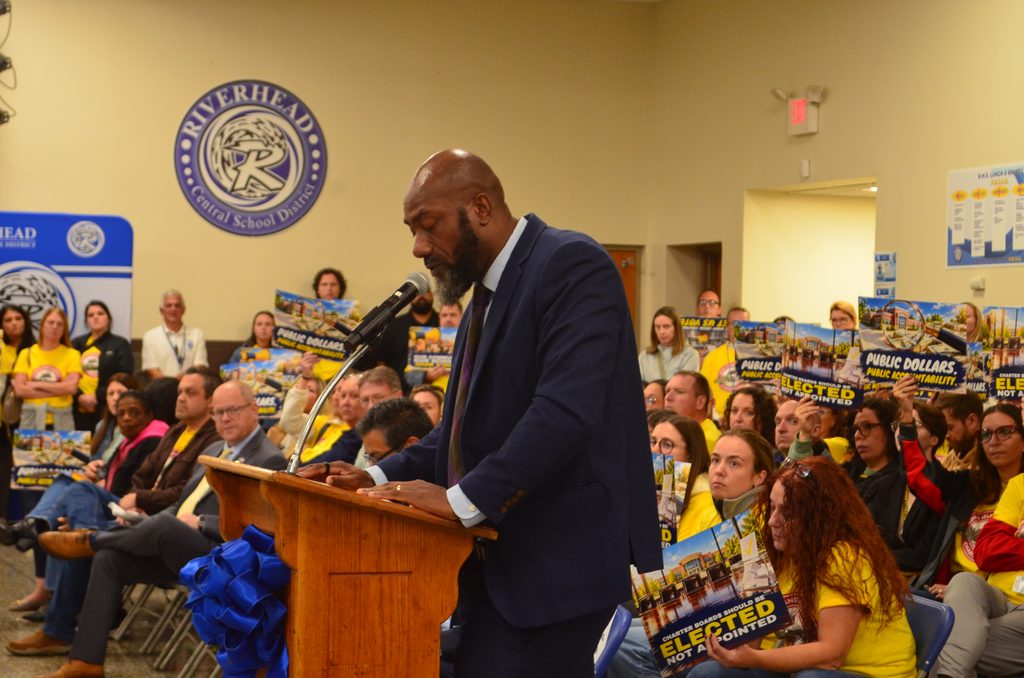
At present, Riverhead Charter School has 1,054 total students and employs roughly 140 staff members, according to its superintendent, Raymond Ankrum, who opened the public comments before leaving shortly afterward.
He described Riverhead Charter School as a tuition-free, nonprofit public school governed by a board of trustees that enrolls students by lottery and serves students with disabilities and English language learners. Additionally, about two-thirds of its students qualify for free or reduced-price lunch and nearly nine out of 10 students are Hispanic or Black, he said.
Mr. Ankrum stressed that the per-pupil rate is set by a state formula, and the charter school must receive renewal to continue operating beyond its current term. He listed various statistics and achievements, including students earning 75% proficiency in math and 73% in reading on the previous year’s state exams.
Riverhead Charter School also ranked 16th out of 123 K-12 public schools in New York, and its middle school placed third in Suffolk County, according to Mr. Ankrum.
“What we ask: keep children out of this debate, respect the choice families make, and work with us where we already share responsibility — transportation, special education, and the safety of every child at a bus stop in this town,” Mr. Ankrum said.
Elected officials also spoke against the five-year renewal, including Assemblyman Tommy John Schiavoni, Riverhead Supervisor Jerry Halpin and state Assembly Deputy Speaker Phil Ramos, who said Riverhead taxpayers have paid approximately $105 million in charter school tuition over the last decade.
Mr. Ramos and other speakers cited projections by district officials of more than $19 million in total charter-related expenses during the 2026-27 school year, including transportation, nursing and special education costs.
Last year, the charter school tuition cost for the Riverhead Central School District was roughly $16.5 million, according to the assemblyman and budget documents.
Charter school advocates say taxpayer funding generally follows the student, but Mr. Ramos argued that district costs like buildings, transportation and special education do not disappear when students leave, putting pressure on district budgets, taxes and the ability to provide services and essential programming.
He emphasized that his criticism is not directed at charter students or families, but at the possible financial and educational consequences of the state granting the five-year renewal.
“These are figures that deserve serious scrutiny, because behind every budget is a classroom, behind every staffing decision is an educator, and behind every educational opportunity is a child whose future may depend on it,” Mr. Ramos said. “This discussion is about something much bigger than one school — it’s about who makes decisions affecting our children’s education, it’s about who controls our public dollars.”
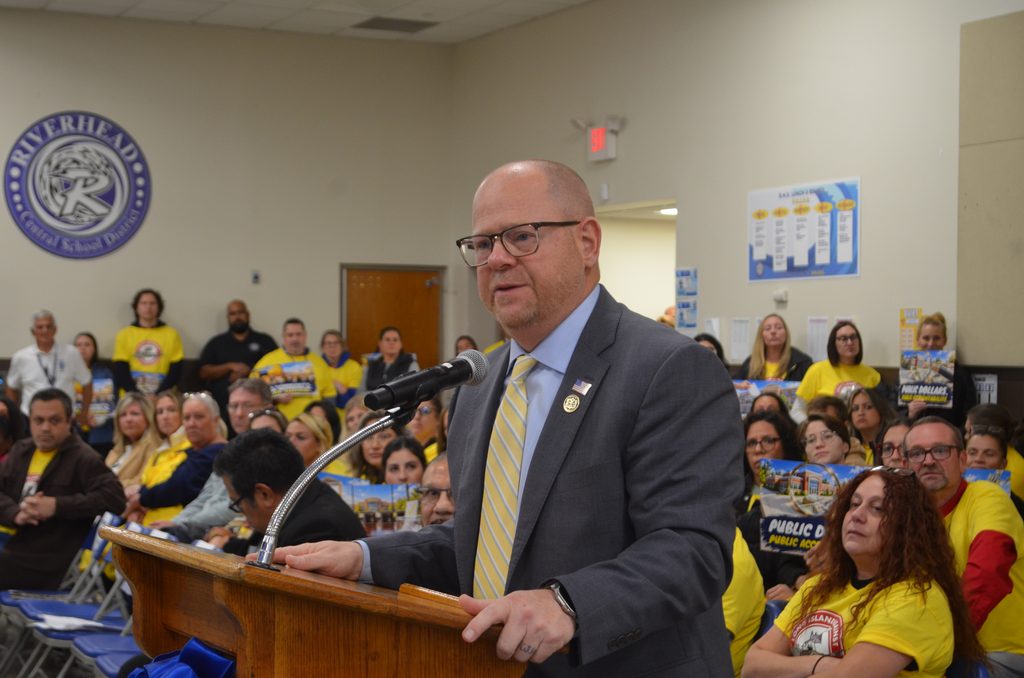
Riverhead Supervisor Jerry Halpin said any taxation should require representation and public input (Credit: Ana Borruto). 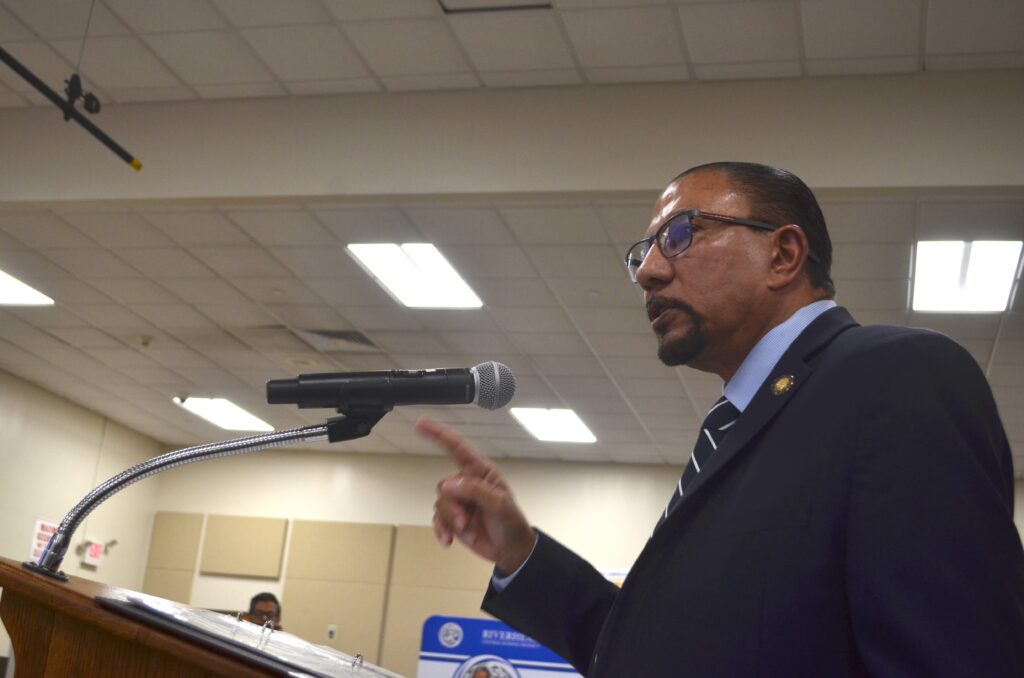
Assemblyman and deputy speaker Phil Ramos is sponsoring a proposal bill that would require local approval of charter schools (Credit: Ana Borruto). 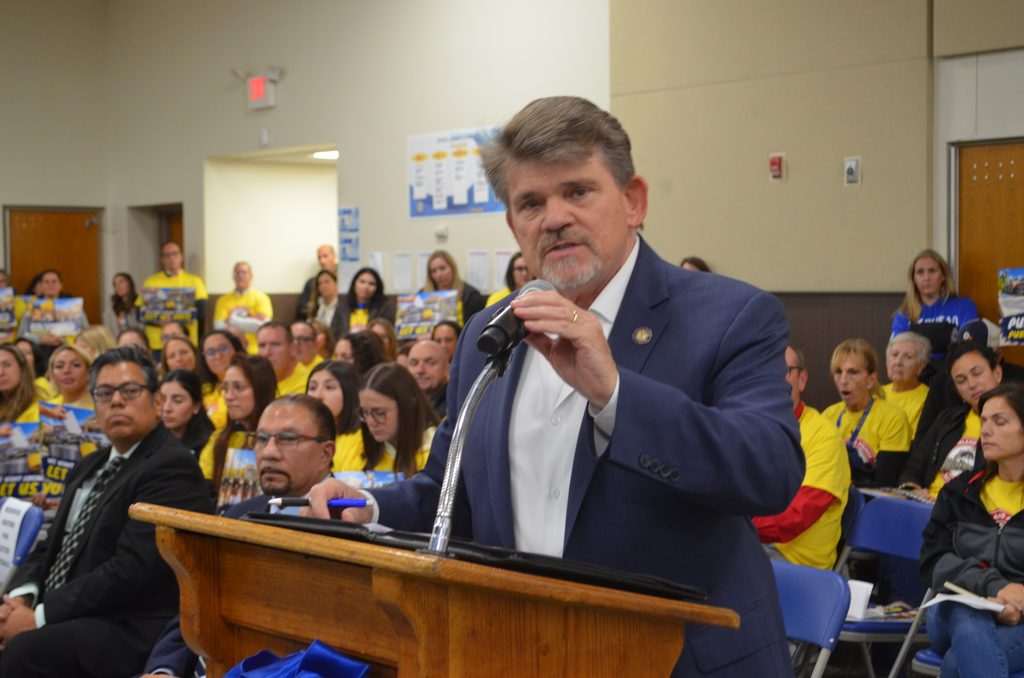
Assemblyman Tommy John Schiavoni called on financial transparency from charter schools (Credit: Ana Borruto)
Some critics questioned the charter school’s ability to appropriately serve students with disabilities. In 2024, Mr. Ankrum told the Riverhead News-Review that Riverhead Charter School was looking into a special education pilot program.
At the time, the superintendent said the charter school loses a large number of students annually in special education because a lack of space prevents it from providing the services they need.
“How can the public be confident in a five-year renewal without clear evidence that these programming limitations have been corrected,” asked Jenn Simoes, vice president of the Riverhead Central Faculty Association. “Students with learning disabilities deserve appropriate placements, individualized instruction, and the full range of services necessary for their educational success — their educational needs cannot be treated as an inconvenience or a reason to transfer responsibility elsewhere.”
Other speakers took issue with the fact that local residents do not elect charter school trustees or vote on the charter school’s budget, unlike district school board elections and budget votes.
Gregory Wallace, president of the Riverhead Central Faculty Association and co-chair of Long Island Against Charter Schools, pointed out that the charter school’s trustees are appointed, not elected, and are not required to live in the school community. He noted that its board president, David Edwards, lives in Los Angeles.
He and others called for stronger oversight and accountability, backing Mr. Ramos’ proposed legislation requiring a public vote before a charter school outside New York City opens, expands or renews its charter in a community.
“This is the very definition of the loss of local control, and it is unequivocally taxation without representation,” Mr. Wallace said. “If a charter school is operating in a community and drawing funds from that community, then people who live there should have a say — let us vote.”
Riverhead Charter School was founded in September 2001 as a K-6 school. At the start of the 2022-23 school year, it opened a high school campus at the refurbished Old Northville School House on Sound Avenue. In 2023, the school’s charter was expanded, allowing for the addition of 11th and 12th grades and expanding enrollment to 1,244 students. Prior to that, students in grades 9 and 10 shared the building at the school’s campus on Middle Country Road in Calverton with K-8 students.
Its expansion bid on Sound Avenue was met with major backlash from Riverhead residents and school district educators in 2024, eventually prompting the charter school board to withdraw its development application.
Last year, Riverhead Charter School got the green light from the Town Board for a special permit to install three 960-square-foot temporary trailers on its Sound Avenue high school property.
School officials have long been searching for a new location and are currently in contract to build a high school, middle school and athletic fields at the school’s newly acquired property at 4314 Middle Country Road in Calverton, on the corner of Route 25 and Fresh Pond Avenue.
With a few years left on the current lease at Sound Avenue, the school will use the trailers as a temporary solution to address growing enrollment numbers while construction takes place at the Calverton property, the News-Review previously reported.
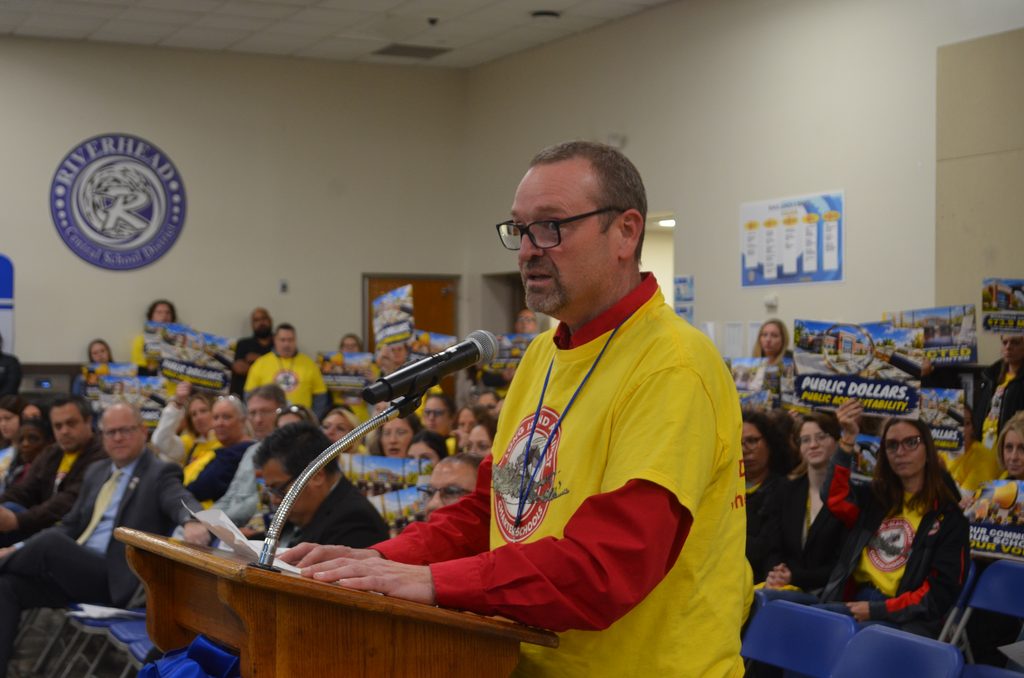
Aside from the comments made on the record in the packed Riverhead Middle School cafetorium, with additional attendees accommodated in the gymnasium, the district also received 388 letters on the matter. Mr. Ankrum noted that 18 families and staff members submitted letters in support of Riverhead Charter School.
After an extensive evaluation and consideration of the public hearing comments, the Board of Regents can grant the charter school a full five-year renewal, a shorter term — typically three years — or deny renewal.
Superintendent Bob Hagan said the next step is for the Riverhead Central School District to package the recorded comments and send them to the state Board of Regents.
“I’m overwhelmed by the support — all these different school districts came out on their own time to not only support us, but support public education,” said Mr. Hagan, following the meeting. “I’m just grateful, it means everything when we’re talking about children, teachers and everything we do for our communities.”