Riverhead Town hears from public on cannabis moratorium

Riverhead held a public hearing on the proposed moratorium on cannabis businesses at the Tuesday, Aug. 19 town board meeting. The proposed moratorium comes on the heels of a recent state Supreme Court decision that struck down some of the Town’s zoning rules regarding cannabis establishments, citing the state’s preemptive authority.
According to planner Matt Charters, the town board adopted zoning regulations for cannabis uses, which have been amended twice thus far. These regulations were the result of significant public engagement, including a town committee that provided specific recommendations concerning cannabis regulations within the town.
State legislation allows the town to implement time, place of manner and saturation restrictions for cannabis businesses. The town contends that these allowed restrictions include distance requirements that exceed the state’s. The one-year moratorium would allow Riverhead to appeal the recent decisions and evaluate their options. The moratorium would not affect stores that are already open or sites that have been granted a site plan approval.
“I think we put together really great legislation to make it fair and equal throughout the town [so] that no one particular area was going to suffer at the hands of multiple stores in one location,” said Councilman Kenneth Rothwell. “That’s why we have implemented the saturation rates. We protected our schools, our churches, our town parks. I think it was great legislation, but I think at this point, if a judge is going to take away our authority for home rule from us, not to allow time place and manner, then we need to pause the entire process altogether.”
Supervisor Tim Hubbard also stated his support for the moratorium, citing the usurpation of local control. “If New York State had indicated in the beginning that when we were trying to decide to opt in or opt out of this, that they would have say on local law, I assure you, my vote would have been very much different, because we were assured that we had control of time place and manner,” said Mr. Hubbard. “And they appear to be taking that back now from us, and that’s very disturbing, and is one of the reasons we decided also to put this moratorium together.”
While the main purpose of the moratorium would be to evaluate the state’s preemption of Riverhead’s zoning rules, much of the public discussion revolved around whether or not cannabis consumption is harmful, especially for children.
“The dispensaries are not harmless,” said Gwen Collins of Riverhead. “They will increase traffic, criminal activity and the risk of crime. And most dangerously, they normalize marijuana use, especially in our youth. No matter what the packaging or marketing sets, cannabis is still in trouble. It’s an entry drug or a gateway drug that affects developing minds in ways we’re only beginning to fully understand. We should not accept a vision of progress that puts profit over people and our community’s health. We owe it to children and grandchildren.”
Brian Stark, of Stark Enterprises, stated that he had warned the town when they were creating the zoning that it was in violation of the state law. “I am one of the first licenses given on Long Island. I am the first license in the town of Riverhead that was fully given the license from the OCM [New York State Office of Cannabis Management]. I’m still not open,” said Mr. Stark. “I hear these comments that you guys want to pass a moratorium due to health and safety. I’ve been all around this state. I’m involved in all cannabis activities. I have not heard of any health and safety issues across the state from a dispensary opening.”
It is possible that the moratorium itself is a violation of state law. Additionally, towns cannot opt out of cannabis sales once they have given the green light to the businesses.
“The town of Riverhead has opted into cannabis retail, and you don’t have the right to opt back out,” said Gahrey Ovalle, co-founder of the Long Island Cannabis Coalition. “That ship has already sailed, and your attempt at placing a moratorium on further and future cannabis retail is the town’s way of shirking their responsibility in an attempt to not be compliant with New York state law.”
Mr. Ovalle also stated that legal dispensaries help to tamp down unlicensed sites, which are less secure. “If you won’t allow legal cannabis to operate, you are by nature allowing illicit cannabis to operate. And these are the stores that our children have access to. These are the stores that market to our children, that they can walk into and potentially purchase product,” said Mr. Ovalle.
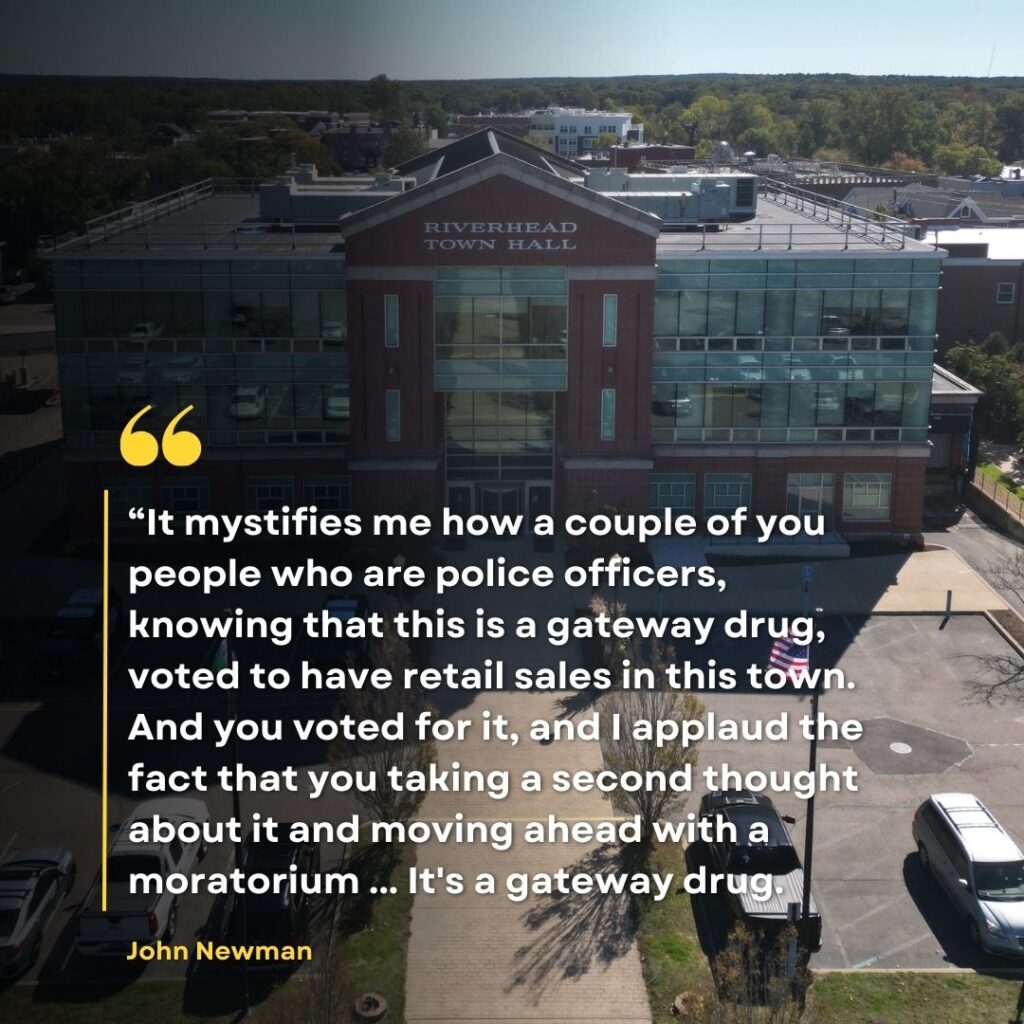
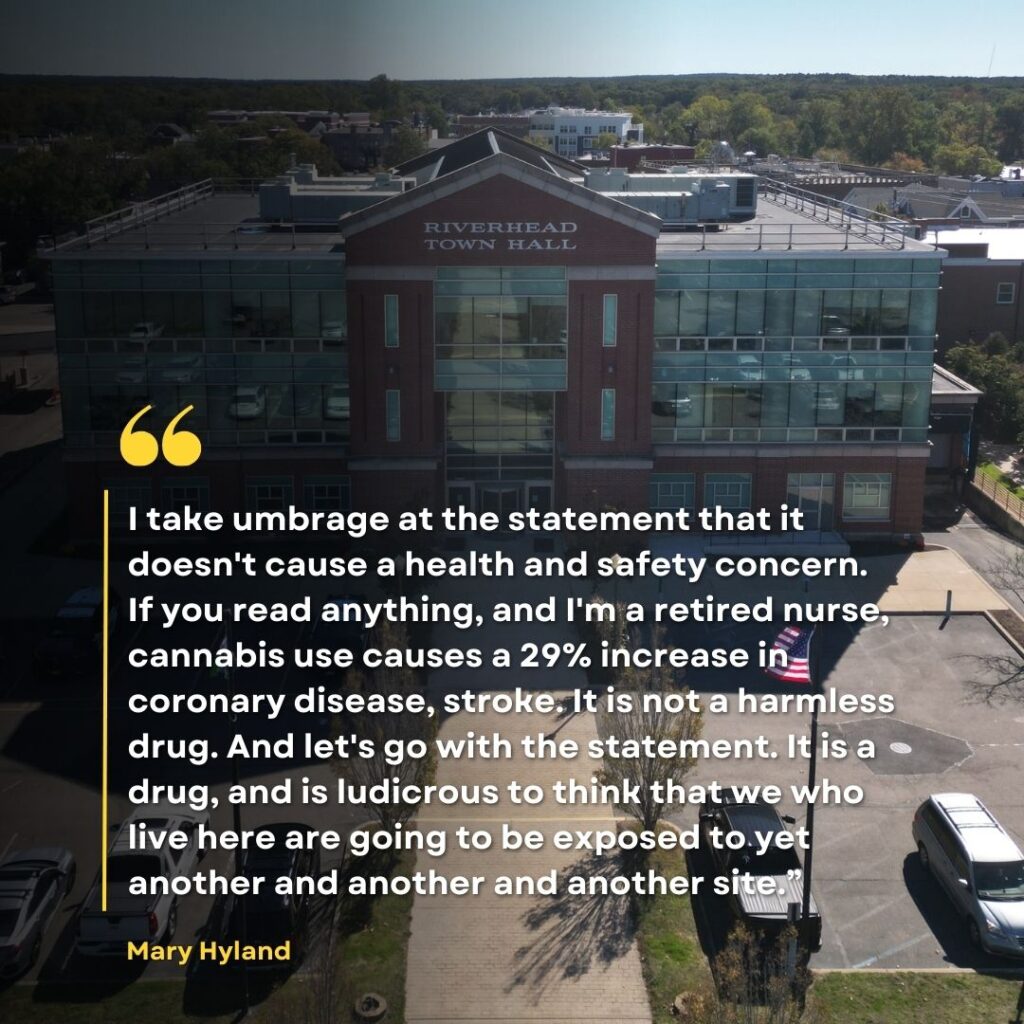
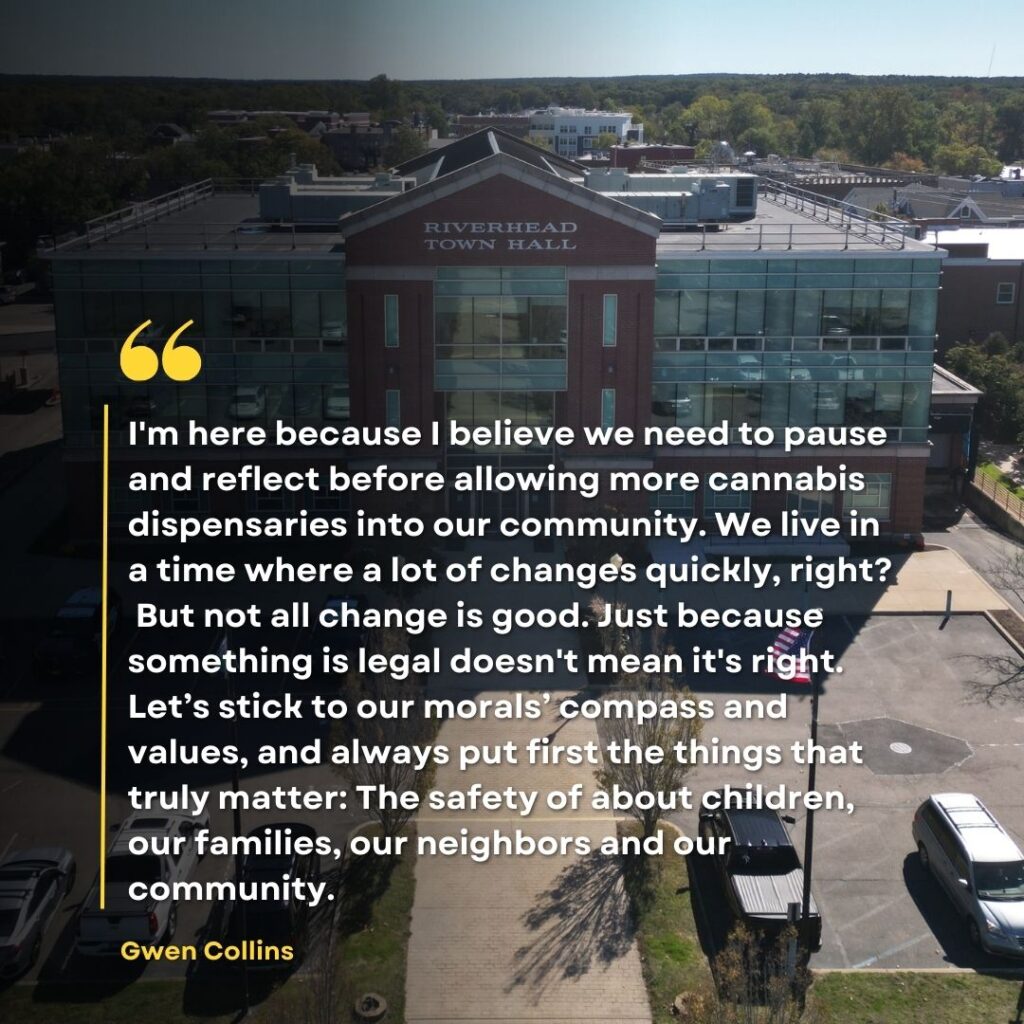
As the public comment veered off course into the health and social effects of marijuana use, Mr. Hubbard brought the discussion back to the issue at hand: home rule and the zoning of cannabis retail operations.
“The reason we put the moratorium up is not whether marijuana is a gateway drug or not, because you can read stories that say both sides of the coin,” said Mr. Hubbard. “You can read stories that say alcohol is harmful to you. We have alcohol being sold in town all over the place. This isn’t what this is about. What this is really about is a zoning issue. The town should never, ever have to allow the state to tell them where, when they can zone certain things … I would not have voted for this knowing that the state was going to step in to take control and say, ‘Hey, no, we gave you a chance to do your own zoning. We don’t like it. You’re going to do what we want you to do.’”
Mike Foley, a resident of Reeves Park, brought an alternative perspective. An avid marijuana user, he came down in favor of a moratorium, stating that Riverhead Town should be the authority to make decisions when it comes to their own zoning.
“This moratorium came about for one reason and one reason only, because the state of New York challenged the time, place, and manner rights of the town of Riverhead. This is not about weed. This is about the state overreaching on what we’re entitled to do as a town, and the five town board members that we elected to represent us,” said Mr. Foley. “I support this moratorium for that reason. I think we should put it on because not doing that would allow people to violate, the applicants to violate, what we say as the town of Riverhead, as what we want in our town.”