Calverton RAB urges Navy to consider county health data from private wells
The Calverton Restoration Advisory Board has announced plans to host its own public meeting where the Suffolk County Health Department can present its independent testing data of private wells at the former Grumman site to the residents, after the U.S. Navy declined to have county officials present its findings.
RAB members, who have served as a liaison among community members, government officials and Navy during this now decades-long cleanup process, are aiming to schedule this open meeting at Riverhead Town Hall, in conjunction with Suffolk County Executive Ed Romaine, Riverhead Town officials, Suffolk County legislators and county health officials, for early March.
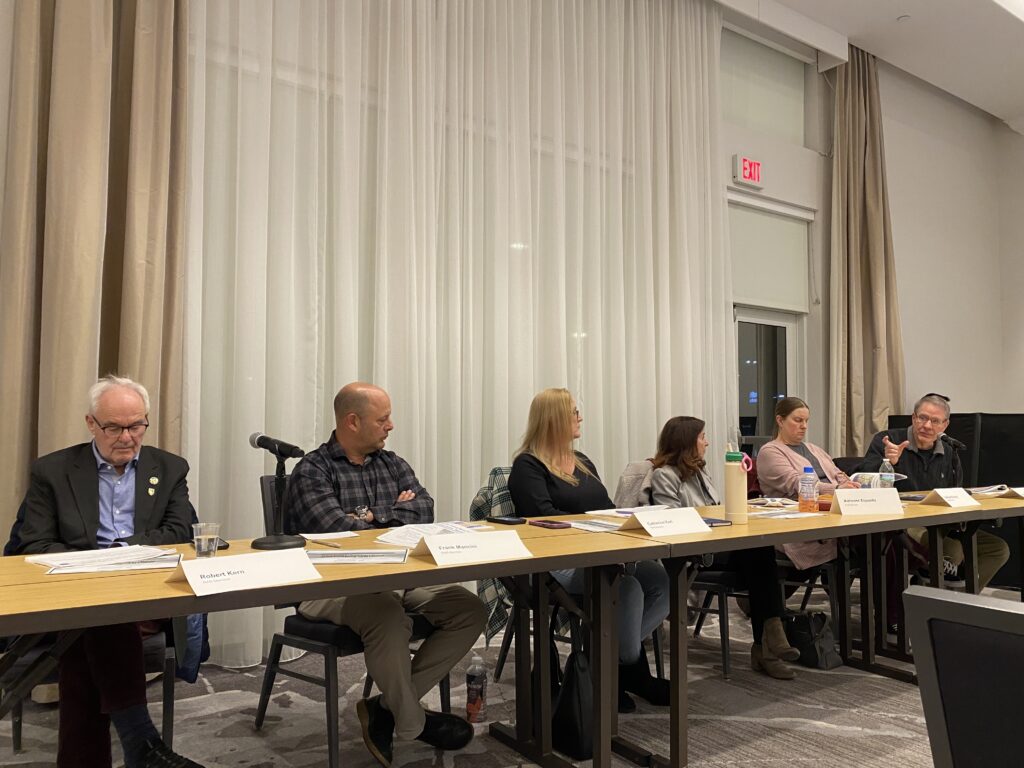
RAB member Adrienne Esposito, executive director of Citizens Campaign for the Environment, shared at the Feb. 10 meeting with the Navy that the RAB previously requested that the county perform the private well data testing because the advisory board felt it would give the public a “bigger picture” of groundwater contamination and any potential risks.
Frank Mancini, superintendent of the Riverhead Water District and RAB member, told the Riverhead News-Review on Monday he has not yet seen the results of the testing the Suffolk County Health Department has conducted over the last year. However, he said they collected private well data within a three-mile radius, rather than the Navy’s one-mile radius sampling.
County health officials have also looked into areas previously deemed cleared of contaminants by the Navy and the former management of the New York Department of Environmental Conservation, Mr. Mancini said.
Ms. Esposito expressed disappointment at the Navy’s claim that it is against protocols to allow other agencies to present data, and that is why the additional county data was turned down.
The cleanup activities are funded through the Navy’s Environmental Restoration Program initiative, which identifies, investigates and cleans up former waste disposal sites on military property. Addison Phoenix, the Navy’s manager for the site, said the Navy must follow federal policies and regulations on certain lab collections, sampling and data generation methods.
“We are aware that there has been a lot of effort done by Suffolk County, that there’s interest from the community in having [their findings] presented here,” Ms. Phoenix said. “From the Navy’s perspective, that is not fitting into that defense environmental restoration program discussion, and so that is not something that we’ve encouraged at this time.”
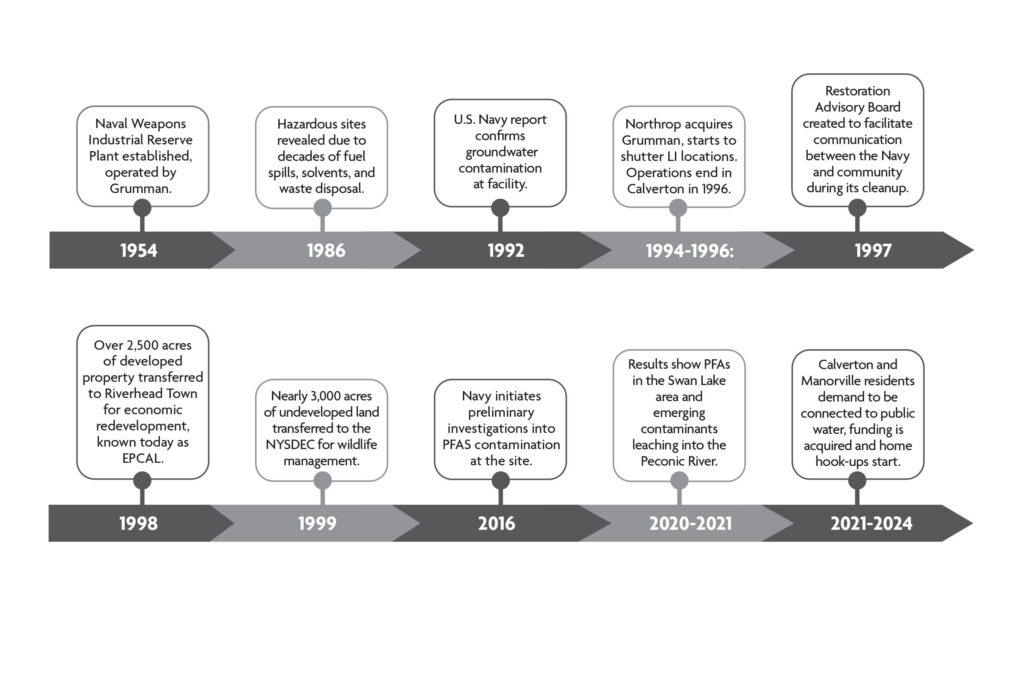
From the development of the Naval Weapons Industrial Reserve Plant to the present day, the Calverton site has seen significant change in function, ownership and reception by the public. What was produced and tested at its facilities has left a lasting impact on the land, with advocates today pressing the Navy for more comprehensive testing and cleanup of the site.
The Naval Weapons Industrial Reserve Plant was established in 1954 as a government-owned facility operated by Grumman to develop, assemble and test Naval combat jets. The facility was also used for paint shops, machine shops and degreasing and storage of oil and chemicals.
The former Grumman site was used for building and testing military aircraft until 1996, when the company left Calverton. Since then, groundwater pollution at the site has been attributed to the decades of aircraft production. The Navy first identified the presence of PFAS in the area’s groundwater in 2016.
The source of the contamination has been traced to aqueous film-forming foam, a firefighting foam that was in regular use when military aircraft were being built and tested there. The foam contains toxic chemicals including PFAS that have been linked to cancer, liver damage, fertility problems and asthma.
In its latest RAB meeting presentation, the Navy also identified 62 total potential releases of 1,4 dioxane in areas across the former facility in its preliminary assessment. The liquid is found in industrial products such as aircraft deicing fluid, and is primarily used as a stabilizer in chlorinated solvents, Navy representatives said. It is also an unintended byproduct in several household items, such as detergents, cosmetics and shampoos.
The Navy’s primary focus is following the Department of Defense’s environmental restoration program manual and CERCLA process, which is the Comprehensive Environmental Response, Compensation, and Liability Act, or “Superfund,” to remediate PFAS, volatile organic compounds (VOCs) and other contaminants at the former Grumman site.
Ms. Phoenix said the Navy feels “very confident” in the data they have generated so far, but acknowledged that data gaps do exist. She also clarified that Suffolk County’s public health effort looks beyond just PFAs, or perfluoroalkyl and polyfluoroalkyl substances.
Many RAB members criticized the CERCLA process and how the Navy said it is being used to test emerging chemicals individually, rather than sampling at the same time.
Francesca King, a representative of the New York State Department of Environmental Conservation, and Navy representatives said the Grumman property historically went through the CERCLA process for evaluation of VOCs and most sites either went under long-term management, or were closed out. However, when PFAs and 1,4-dioxane came on the scene, the process had to restart.
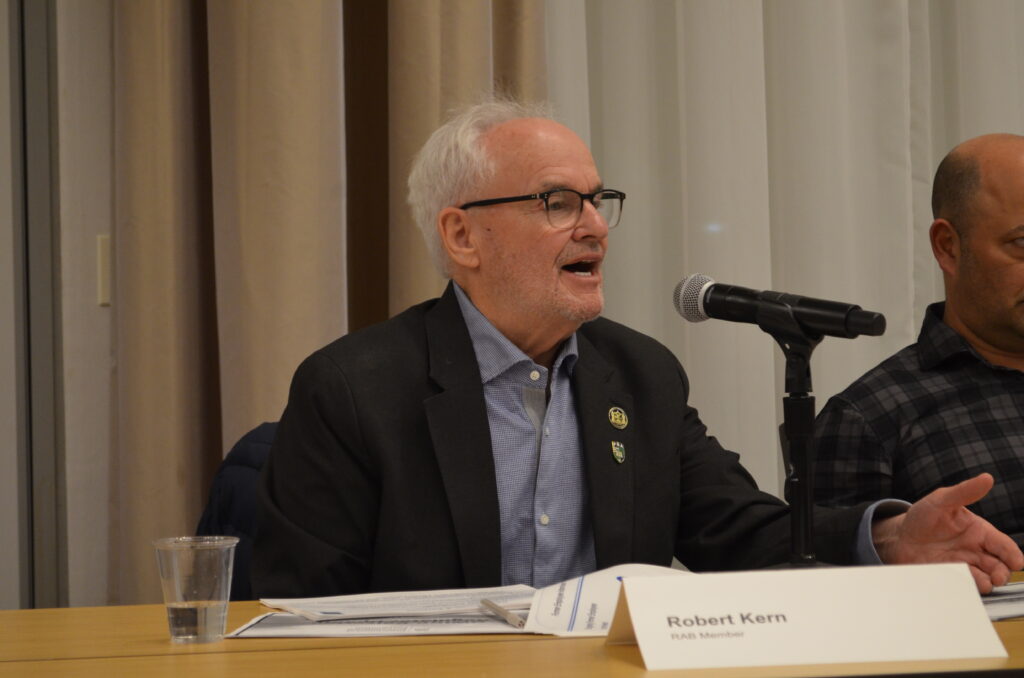
Riverhead Town Councilman Bob Kern called this process a “stalling tactic” and other members questioned the validity of CERCLA behind the Navy’s approach to testing and sampling.
Andrew Rapiejko from the Suffolk County Department of Health Services brought up Brookhaven National Laboratory’s efforts to test for VOCs and all contaminants of concern when they conduct their risk assessments.
“If you’re sampling for PFAs, why don’t you just sample for 1,4 dioxane? I think that’s very frustrating,” Mr. Rapiejko said. “It’s dragging it out because you’re just looking at one chemical at a time, and you’re not going to get to that point where you can do a complete risk assessment for years.”
Mr. Mancini also mentioned the action taken by the Navy around 2009 after a Suffolk County Health groundwater investigation revealed much higher levels of VOCs detected in wells near the Peconic Sportsman’s Club than the Navy previously asserted.
“It was the Suffolk County Department, in fact, Andy [Rapiejko] himself, who went there with their team and drilled vertical profile wells along the southern end of that property, showed up to a RAB meeting, was allowed to present that data, and forced the Navy to take ownership of that plume, despite denying it up to that very point,” Mr. Mancini said. “This is a terrible strategic move to not let them present because it has opened the door to what was going on at the site before.”
A date is to be determined for the Calverton RAB meeting at Riverhead Town Hall.