Riverhead mobile stroke unit proposal sparks debate as hospitals expand care
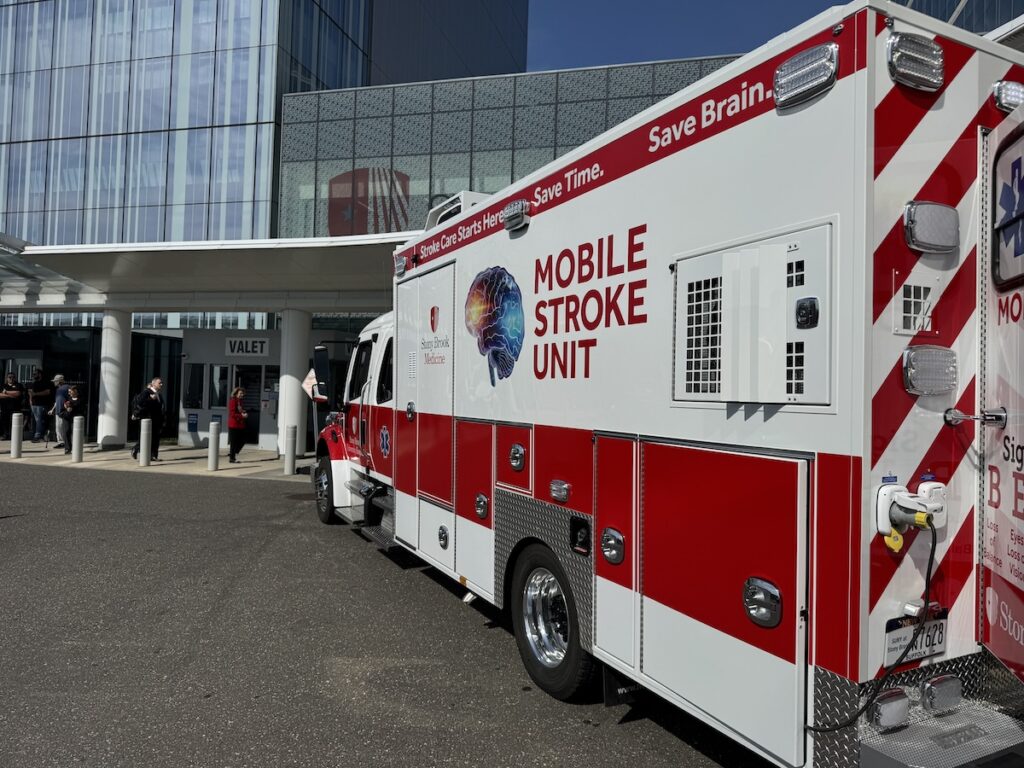
A proposed Riverhead base for a Stony Brook University Hospital mobile stroke unit is igniting a debate over how — and where — East End stroke patients should be treated, as local hospitals rapidly expand their own capabilities.
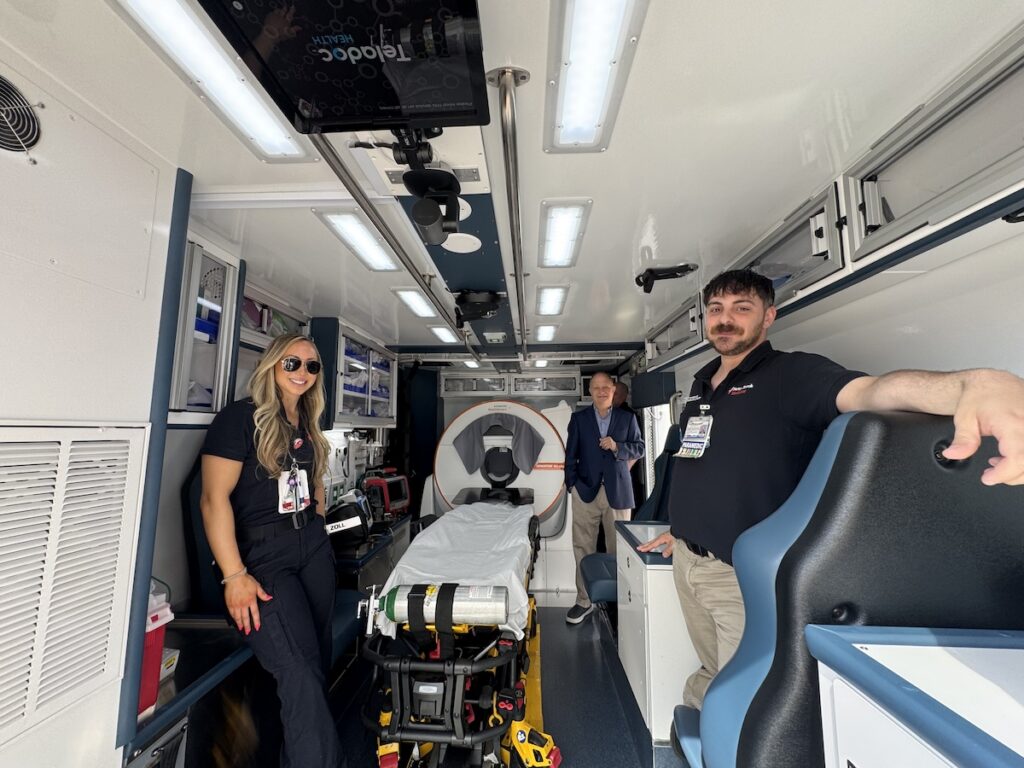
The $1.5 million Mobile Stroke Unit, operated by Stony Brook University Hospital, is an ambulance equipped with a CAT scan that allows doctors to diagnose strokes in the field and route patients to the most appropriate hospital.
The Stony Brook-based hospital has petitioned the Riverhead Zoning Board of Appeals to approve a 14,236-square-foot ambulance storage bay at Staples Plaza that could house the unit along with up to eight ambulances.
Supporters say the approach speeds care for the most severe strokes. Critics argue patients are better off being taken directly to nearby hospitals — especially as facilities like Peconic Bay Medical Center expand advanced stroke treatment.
Stony Brook officials say the unit would complement local hospitals by determining the type of stroke before a patient reaches the emergency room.
Dr. David Fiorella, director of the Stony Brook Cerebrovascular Center, said the unit can identify severe strokes and directs patients straight to thrombectomy-capable hospitals, avoiding delays from transfers.
“The ability to give it at the patient’s door rather than the emergency room door … markedly reduces death and disability from stroke,” he said.
During an April 16 tour of the Mobile Stroke Unit at Stony Brook, Dr. Fiorella said patients with less severe strokes could still be taken to nearby primary stroke centers, including Peconic Bay Medical Center or Stony Brook Eastern Long Island Hospital in Greenport.
PBMC president Amy Loeb said in a phone interview Monday she is concerned a mobile stroke unit planted directly adjacent to a hospital that can provide thrombectomy could cause delays in care. Additionally, she argued that MSUs are better suited for rural or densely-populated urban areas.
“There was a point in time where we actually assessed whether or not that was the best care for this community,” Ms. Loeb told the Riverhead News-Review. “But it’s clear that we are best positioned in this community to have the thrombectomy available in the community.”
The Riverhead hospital — part of the Northwell Health system — recently unveiled a new $7.3 million neuroscience center that will make it the only facility on eastern Long Island capable of performing cerebral mechanical thrombectomies once fully staffed later this year.
Currently, the closest thrombectomy-capable hospitals are Stony Brook University Hospital and South Shore University Hospital in Bay Shore — as far as 37 miles away.
Nearly 2 million brain cells can be lost each minute during an untreated stroke, making speed of treatment critical — whether in the field or at the hospital.
PBMC already treats about 1,000 stroke patients annually and transferred roughly 300 cases to medical centers west of Riverhead last year for advanced care, according to previous reporting. The new center is expected to reduce those transfers and keep more patients local.
Dr. Fiorella said the mobile unit is designed to support that shift — not compete with it — and could route patients to PBMC once its thrombectomy program is operational.
“We don’t need those patients at Stony Brook,” he told the News-Review on April 16. “Stony Brook is a tertiary-care hospital — we don’t want every single stroke in Suffolk County coming here for a small vessel occlusion that we’re not going to do an advanced procedure on.”
Ms. Loeb said the PBMC’s 24-hour emergency center is “designed for speed.” When an ambulance pulls in, a CAT scan is “within steps,” with a full team available to treat a patient. With the MSU, she said the wait for scan imaging is “minutes that could be spent on your way to the hospital.”
“Bringing a patient directly to the hospital that can provide the stroke care is the most efficient,” she said.
The debate comes as stroke care capacity expands across the East End. Stony Brook Eastern Long Island Hospital was recently designated a Primary Stroke Center, allowing it to provide rapid diagnosis and treatment but not advanced surgical procedures.
The ambulance bay proposal drew debate at an April 2 ZBA meeting, where concerns included emergency access, traffic at the busy shopping center and the overall need for the facility.
The board had previously heard the application earlier this year but reopened the public hearing at Peconic Bay Medical Center’s request ahead of the April 2 meeting, following concerns raised about earlier testimony.
Ms. Loeb questioned whether the Staples Plaza site is appropriate for frequent ambulance traffic.
“I can’t understand how anyone would view it as a safe place for ambulances to come and go,” she said.
Dr. Fiorella, however, expressed disappointment with opposition to the MSU installation in Riverhead aired at the April 2 hearing. He cited case studies showing improved patient outcomes at units in Islandia and Shirley. The Stony Brook MSU has been dispatched more than 10,000 times since implementation in 2019.
“To argue against that, based on considerations that are well outside of patient care, to me it’s really upsetting,” he told the News-Review. “And to see physicians in fact go up and argue this, is disappointing.”
He said the program is designed to operate collaboratively with hospitals regardless of affiliation.
Ms. Loeb said PBMC and Stony Brook University Hospital have not had direct conversations about how the mobile stroke unit would work alongside the Riverhead hospital’s expanding stroke program.
“I’m always open to discussion,” she said. “We have not yet heard from the team at Stony Brook.”
Written comment on the proposal remains open through April 23. The Zoning Board of Appeals is expected to consider a vote May 14.
If approved, the unit would be stationed in Riverhead from 8 a.m. to 8 p.m. and respond to an estimated three calls per day.