Former Russian political prisoner warns about press freedom at Stony Brook lecture
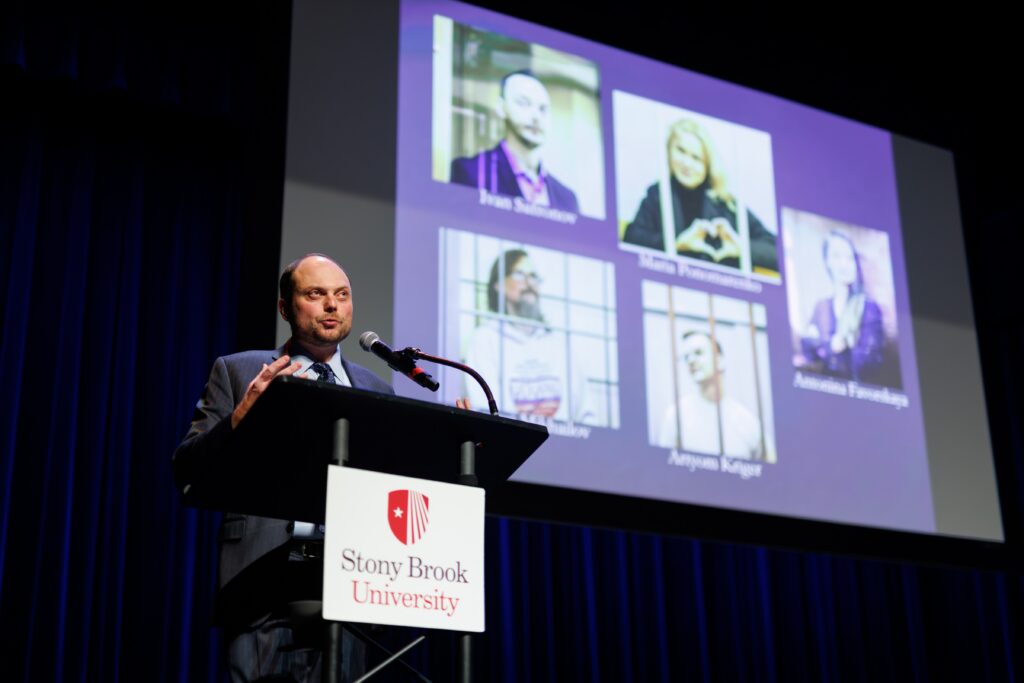
Pulitzer Prize-winning journalist and Russian opposition leader Vladimir Kara-Murza recounted his imprisonment in Russia and warned about threats to press freedom during a lecture Tuesday at Stony Brook University.
Speaking at the Wang Center as part of the 13th Annual Marie Colvin Distinguished Lecture — named for the renowned war correspondent — Mr. Kara-Murza reflected on the erosion of press freedom in Russia and the risks faced by journalists. The event, attended by about 200 people, was hosted by the Marie Colvin Center for International Reporting.
Mr. Kara-Murza traced the decline of independent media in Russia to the early years of Vladimir Putin’s presidency. He described how the government targeted major outlets, including the once-popular television network NTV, ultimately eliminating nationwide independent television.
“There is nothing dictatorships hate more than truth,” Mr. Kara-Murza said. “The first targets of those who seek absolute power are almost always independent media voices.”
He also described the consequences faced by journalists and political opponents who challenge the Kremlin, citing cases of assassinations and imprisonment. Mr. Kara-Murza himself was poisoned twice — once in 2015 and again in 2017 — which nearly killed him.
After surviving those attacks, he continued his political activism until his arrest in 2022, shortly after Russia launched its full-scale invasion of Ukraine.
Mr. Kara-Murza was released in August 2024 by the Biden administration as part of a prisoner exchange involving several countries. He recalled learning about his release only moments before it happened.
“I was certain I was going to die in a Russian prison,” he said. “Instead, I found myself speaking with the president of the United States on the phone.”
Despite his release, Mr. Kara-Murza emphasized that many political prisoners remain in Russia.
“We must not rest,” he said, “until they and all the other political prisoners in Russia are free.”
During a question-and-answer session, Mr. Kara-Murza discussed the uncertainty surrounding political change in Russia and the importance of preparation for a post-Putin era.
“Things in Russia are sudden and unpredictable,” he said. “I could give you 100 scenarios of how political change might come, and it will probably be the 101st — one that none of us thought of.”
Because of that unpredictability, he emphasized the need for Russia’s democratic movement to prepare in advance for a transition of power.
“The time to think is now,” Mr. Kara-Murza said. “When that moment comes, it will be too late to sit down and start thinking about what to do.”
During the discussion, the Russian dissident encouraged students to remain vigilant about the health of democratic institutions.
“Democracies do not just stay there automatically,” he said. “They depend on active citizens who will defend them.”
He was also asked how he maintained his sanity while in solitary confinement for a year in a Siberian prison, where he was given access to pen and paper for less than two hours a day.
Mr. Kara-Murza said the strict limitation meant everything he needed to do — including preparing legal documents, reading letters and responding to correspondence — had to be completed within a brief window each day.
“The guards would bring in pen and paper for an hour and a half,” he said. “Everything I planned to do in a given day had to be squeezed into that time, and then they would take it away again.”
Despite the isolation, Mr. Kara-Murza said three factors helped him endure his imprisonment. The first was his Christian faith, which gave him a sense that he was not truly alone.
“Every minute of every day spent in that Siberian prison, I knew I wasn’t alone,” he said. “They may have thought I was, but I wasn’t.”
His background as a historian also helped him maintain perspective.
“If you look at the history of Russia over the past three centuries, you see this constant alternation between repression and reform,” he said. “This may seem forever, but then it will be no more.”
He also recalled advice from Vladimir Bukovsky, whom he interviewed years earlier while making a documentary about the Soviet dissident movement. When Mr. Kara-Murza asked Mr. Bukovsky how he survived imprisonment, he offered a simple answer: “I knew that I was right.”
At the time, Mr. Kara-Murza said he did not fully understand the remark, but his own imprisonment gave it new meaning.
“For the entirety of my time in that Siberian prison, I knew that I was not the criminal,” he said. “The criminals are the people who started this war and are killing people in Ukraine every day.”
That certainty, he said, helped eliminate fear and doubt during his time behind bars.
“When you know that you are right,” Mr. Kara-Murza said, “the fear and the doubt just go away.”
Michelle Grisales is a reporter with The SBU Media Group, part of Stony Brook University’s School of Communication and Journalism’s Working Newsroom program for students and local media.