Inside the East End nerve center building the U.S. Open at historic Shinnecock golf course

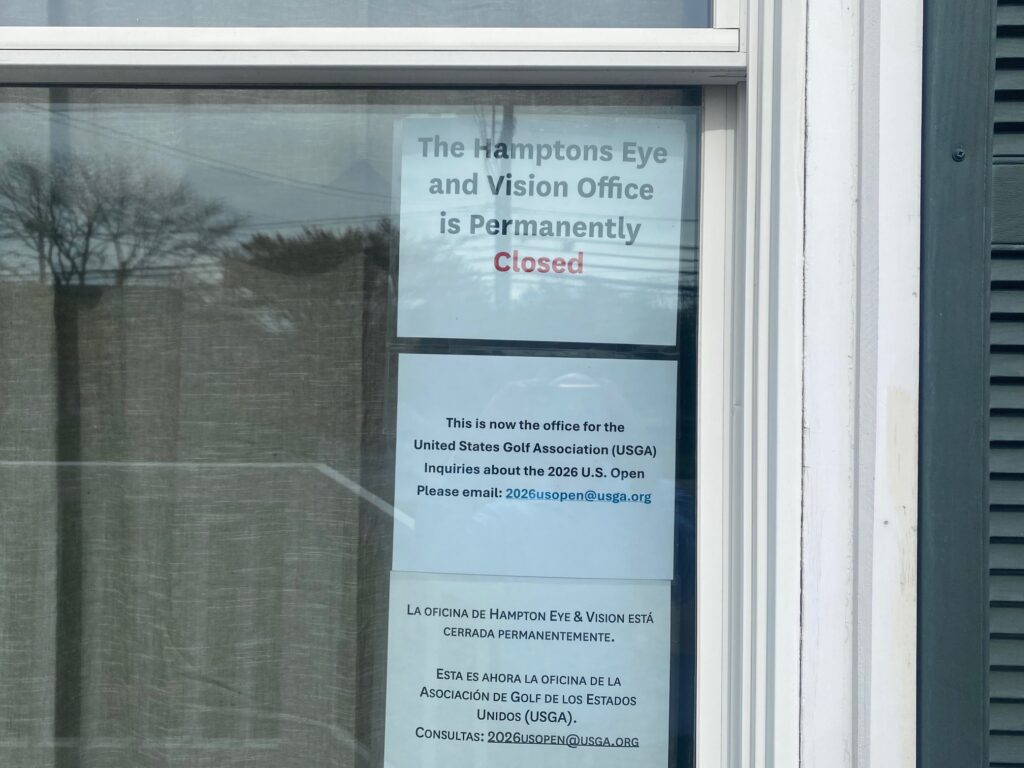
The sign taped to the front window of a Southampton Village home is easy to miss.
“The Hamptons Eye and Vision Office is Permanently Closed.”
Below it, another sheet of paper.
“This is now the office for the United States Golf Association.”
Upstairs in the two-story building on North Sea Road sits the nerve center for the upcoming U.S. Open at Shinnecock Hills, with John Ryan Celiberti working beneath a giant aerial map of the golf course marked up with logistics notes.

The 29-year-old Lynbrook native has spent the past two years on the East End with a small USGA team helping build the operation behind one of golf’s biggest championships.
The 2026 U.S. Open runs June 15-21, with practice rounds beginning Monday and tournament rounds scheduled for June 18-21.
“You’ve got thousands of volunteers, massive parking operations, mutual aid support from different agencies, and operational components that all need to be running simultaneously and seamlessly,” Mr. Celiberti, assistant director for the USGA’s championship team, said during a sit-down with The Suffolk Times last month. “And none of it existed six months before.”
Laptops sit open around his office. Sticky notes cover the walls. There are plenty of logistics to coordinate: bus and train schedules, parking lots and public safety plans.
“Our team is usually two years in advance, working on one week,” Mr. Celiberti said.
Mr. Celiberti arrived in Hampton Bays in 2024 as part of a traveling operations group that moves from championship to championship — Los Angeles, Pinehurst, now Shinnecock — to begin laying the groundwork with a small team that included fellow New Yorkers Brein McGinn and Colleen Fink. After six months of commuting to Southampton, he found a place within walking distance of the former optometrist’s office.
His job: Get people in, get people out.
“Transportation, public safety, clubhouse relations,” he said. “Trains, buses, parking lots, all that type of stuff.”

The U.S. Open doesn’t simply show up in June. Months before spectators arrive, it is built through permits, traffic plans and meetings with town officials, civic associations, transportation planners, law enforcement agencies and emergency responders.
“You have to really make sure we have these relationships early,” Mr. Celiberti said. “That’s really the main reason why we’re here.”
Southampton Town expects crowds to peak around 40,000 people a day during championship rounds. The town will receive about $850,000 from the USGA to cover police, traffic control and public safety costs.
“Everything else in the town does not stop because the U.S. Open is in town,” said Ryan Murphy, the town’s code compliance and emergency management administrator. “People need to be able to move about, go to work, conduct business with the town.”
“The safety of everyone on site, and in motion to the event, as well as around the event, requires tremendous coordination,” Mr. Murphy said.
The logistics stretch well beyond the course itself.
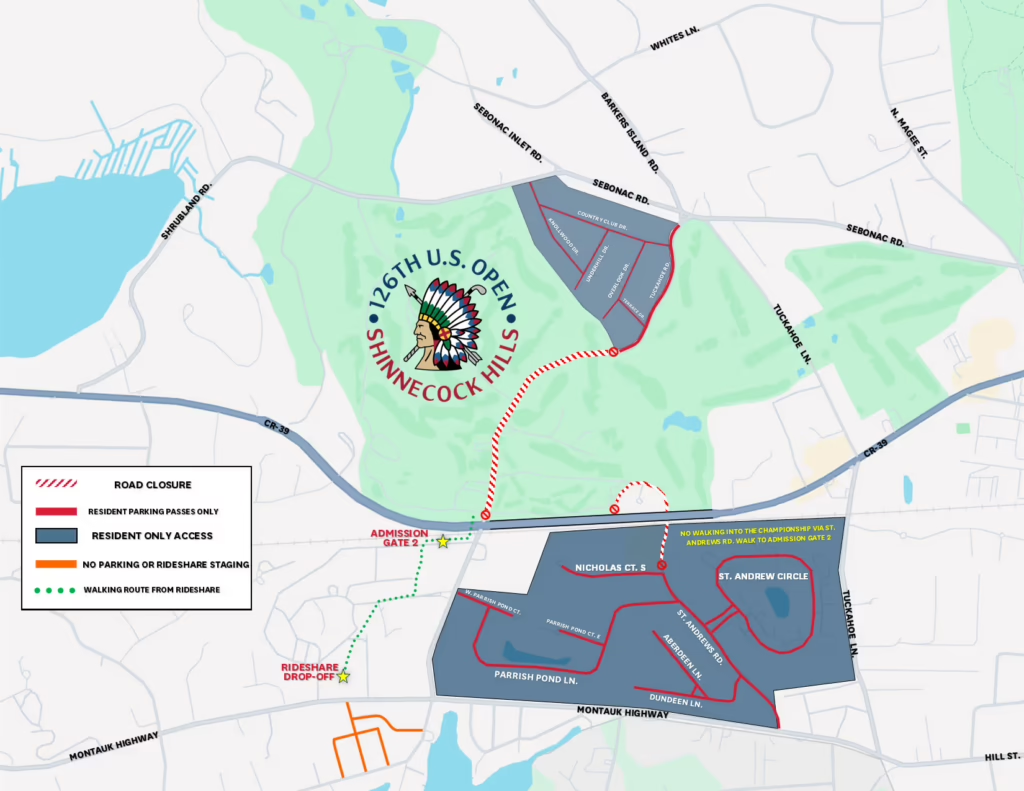
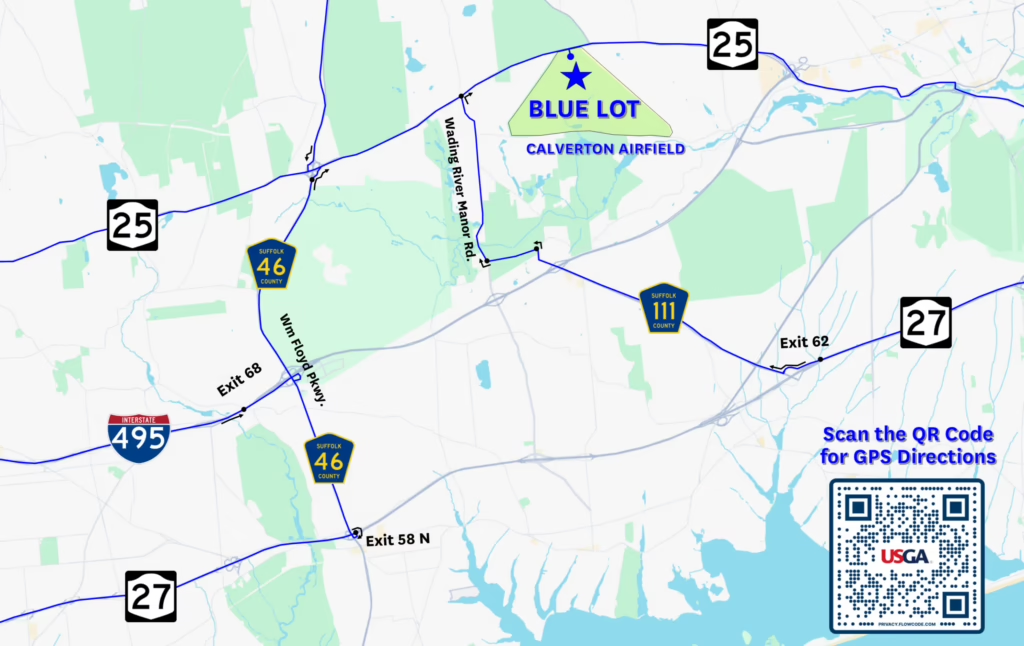
The Long Island Rail Road is adding service on the Montauk Branch and building temporary infrastructure to move spectators. Riverhead Town will host a major parking operation at the Enterprise Park at Calverton, where fans will be screened and shuttled east. Shuttle routes, temporary traffic patterns and pedestrian crossings are being layered into one of the East End’s most congested summer corridors.
The USGA’s own fan guide warns spectators to expect heavy congestion throughout championship week along Sunrise Highway, County Road 39 and Montauk Highway.
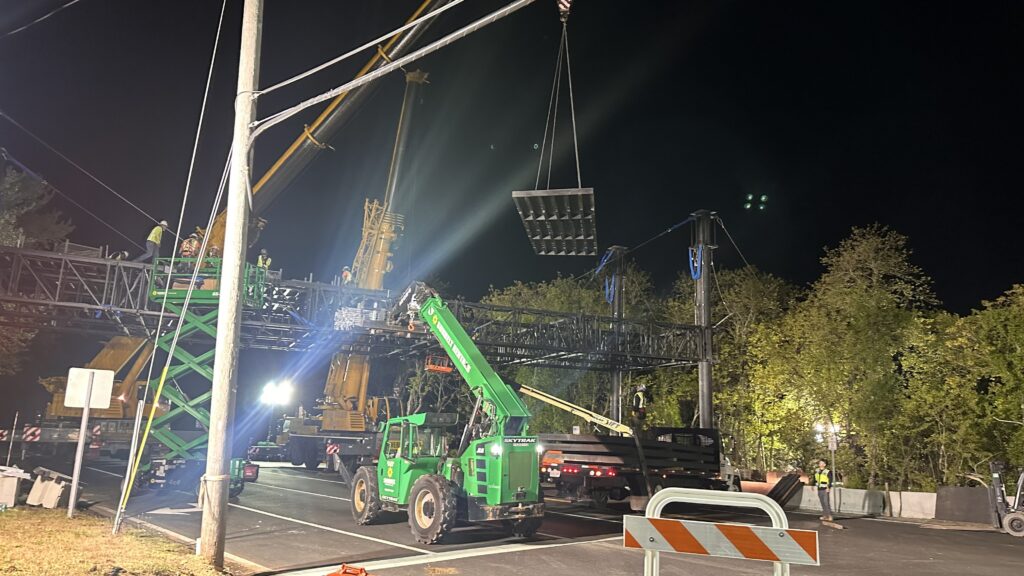
One of the most important pieces is the temporary pedestrian bridge over County Road 39.
Mr. Celiberti had May 20 circled on his calendar for months. That was the night crews were scheduled to install the bridge, one of the biggest pieces of infrastructure tied to the U.S. Open transportation plan.
“We’ve been talking about these dates for so long,” Mr. Celiberti said. “Now it’s actually coming up.”
When it did, the weather made sure no one eased into it.
Eric Steimer, who manages championship infrastructure and operational build for the USGA, spoke the morning after two overnight work windows to get the bridge in place. He was still catching up on sleep.

The plan had been simple enough on paper: Close the road overnight, raise the bridge, reopen County Road 39 before the morning commute.
Then came lightning.
“I think that is the first storm that I’ve seen with lightning,” Mr. Steimer said of his time working in Southampton. “And of all nights, it had to pick the night we’re trying to build a big metal bridge.”
The lightning flashes delayed the start of the work by 90 minutes to two hours. Crews finished raising the bridge frame around 4:50 a.m., just 10 minutes before the road had to reopen. They returned the following night to complete the job.
The bridge is not decorative. It is central to moving spectators.
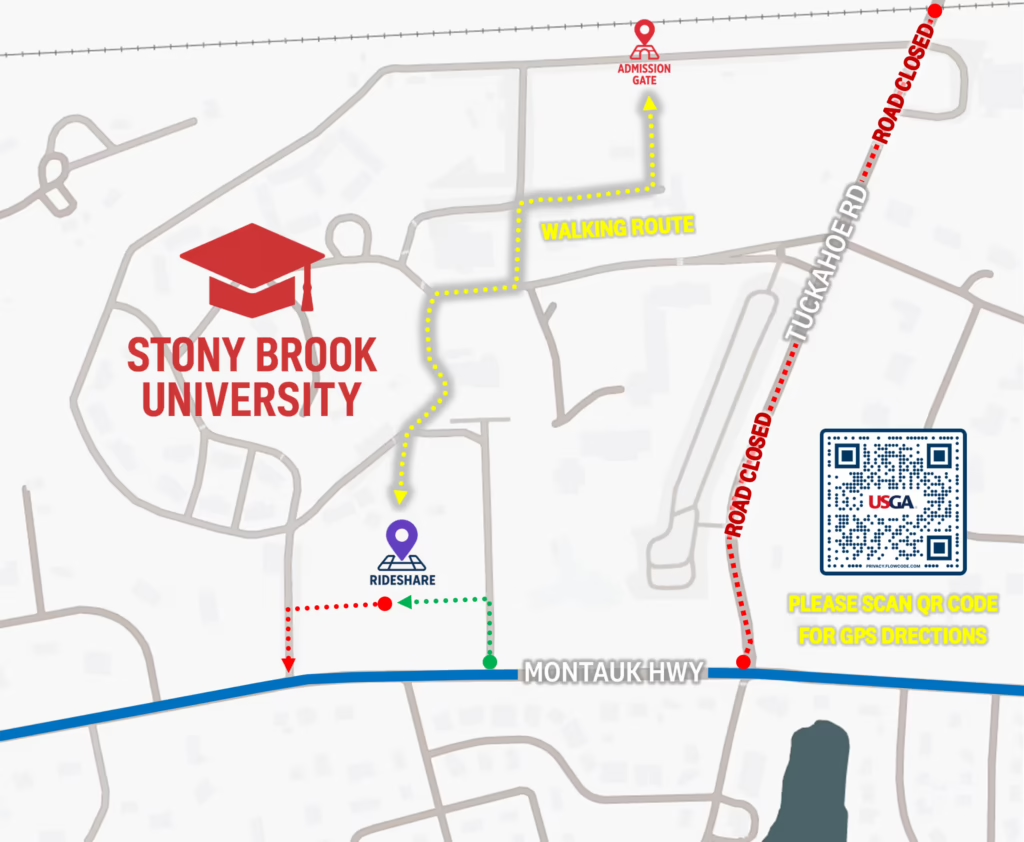
Mr. Steimer said roughly 40% to 45% of attendees are expected to come from the Stony Brook Southampton side of County Road 39, where the LIRR drop-off, rideshare operations, some shuttle service and parking areas feed into the championship.
“The bridge is critical for us just to get people across the road without ever having to shut down or slow down traffic,” he said.
Fans arriving by train will pass through security screening before crossing the temporary pedestrian bridge into the championship grounds.
More than 300 USGA staff, along with dozens of vendors and contractors, are involved in building the championship operation, according to Mr. Celiberti.
Mr. Steimer put the broader scale in even sharper terms: about 3,400 volunteers, as many as 2,500 to 3,000 vendor and contractor employees, and more than 250 tents and temporary structures across the site. The merchandise pavilion alone is more than 30,000 square feet.
The USGA also expects the championship to generate more than $200 million in economic activity for the region. Mr. Steimer said last year’s U.S. Open at Oakmont, outside Pittsburgh, generated more than $285 million in long-term impact.
Drive past Shinnecock now and the transformation is already visible.
“It’s like a little city,” Mr. Celiberti said.
Shinnecock makes all of it harder than the other Opens Mr. Celiberti has worked on since joining the USGA in 2019.
“The geography of the Hamptons doesn’t give you a lot of options,” he said. “With two main roads and one railway, you’re naturally dealing with two significant bottlenecks before you even start planning.”
Mr. Steimer said the USGA has reduced ticket sales by about 15% to 20% compared with past Opens at Shinnecock to ease congestion and improve spectator flow. Tickets remain available, though championship rounds were getting close to selling out.
The build has changed, too. Instead of spreading more single-level tents across the property, the USGA has built upward in some areas, using double-decker structures to reduce the footprint and preserve more open views of the course.
The goal, he said, is to showcase Shinnecock rather than overwhelm it.
The USGA’s answer off-site is a massive park-and-ride system, including a dedicated shuttle lane from Calverton designed to bypass morning backups on Sunrise Highway and County Road 39.
“We know the U.S. Open is going to affect traffic,” Mr. Celiberti said. “We’re not going to solve every long-term issue out here, but we hope our park-and-ride system does a lot of the heavy lifting.”
Even with those changes, the basic East End reality remains.
“Getting to Shinnecock Hills is not easy,” Mr. Steimer said. “Unfortunately, we do not have a solve for the morning rush-hour traffic out here.”
With the bridge now in place, the work turns toward the final stretch, when plans pinned to office walls begin showing up as shuttle lanes, security checkpoints and spectators moving across the grounds.
For Mr. Celiberti, who grew up making summer trips to the East End with his family, the assignment has become personal.
“I always saw it as like, ‘Oh, this is a really cool golf course,’” he said. “I never thought I would be working doing this kind of championship here, so this is a real full-circle moment.”