SCWA sues Riverhead Town over pipeline project
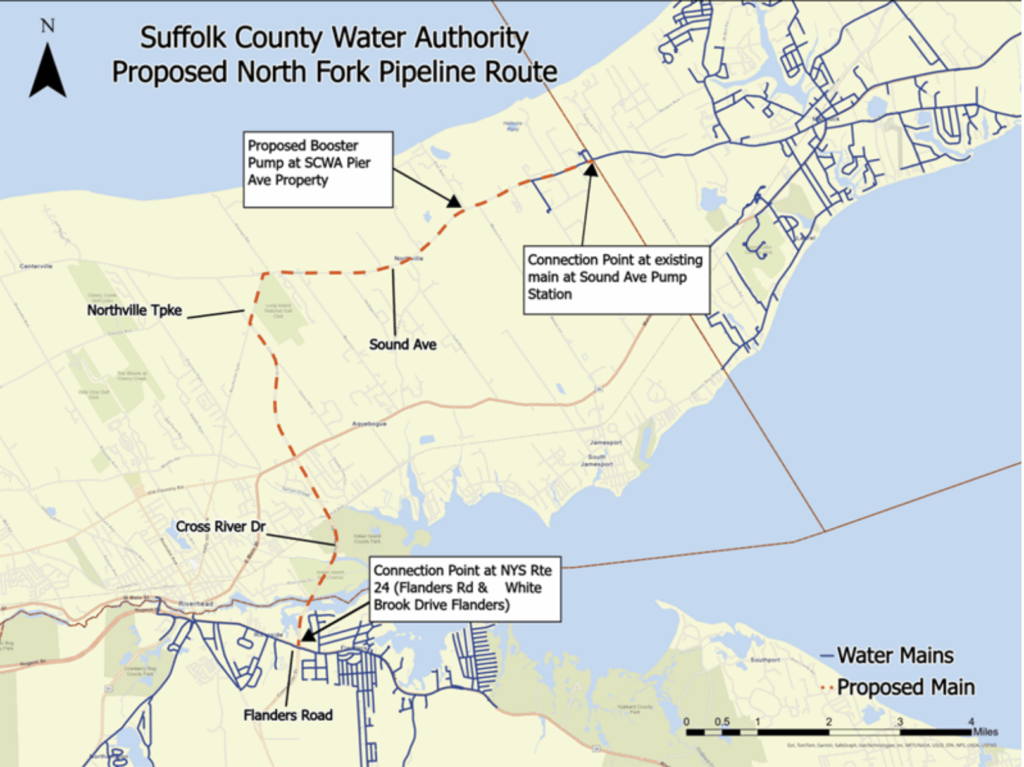
The standoff between Riverhead Town and the Suffolk County Water Authority over zoning control has reached a boiling point, with the SCWA commencing legal action against the town to push forward its 12-mile, $35 million North Fork pipeline project.
The proposed pipeline would run 8.15 miles from Flanders through Riverhead, supplying about 9,500 Southold customers whose existing wells are nearing capacity. SCWA says the project is critical to maintain water pressure and reliability on the North Fork, especially during summer months when irrigation demand peaks.
The lawsuit was filed by the SCWA and its attorney, Kathleen Bennett of the law firm Bond, Schoeneck & King PLLC. In Suffolk County Supreme Court Feb. 6, they alleged that Riverhead’s Monroe Balancing Test determination that SCWA is not immune to local zoning and land-use regulations “was arbitrary and capricious, an abuse of discretion and affected by error of law because the Monroe Balancing Test clearly weighs in favor of immunity,” according to court records.
Riverhead town attorney Erik Howard said in an email to the Riverhead News-Review on Monday, Feb. 16, that the town has yet to be served with the SCWA lawsuit. However, he felt the timing, with the President’s Day holiday weekend, was purposeful.
“I suspect this was done intentionally to prevent Riverhead’s officials from having any substantive comment on action until after the weekend, allowing SCWA to control the initial narrative,” Mr. Howard wrote. “This is consistent with SCWA’s underhanded approach to the pipeline project in general.”
SCWA officials presented their findings under the Monroe Balancing Test at a public hearing on Oct. 9, 2025, and concluded that the agency has immunity from local regulations because it serves as a regional public entity. The Riverhead Town Board voted unanimously on Oct. 7, 2025, to adopt its own Monroe Test results, reaching the opposite conclusion.
The Monroe Balancing Test — named for a 1988 New York Court of Appeals case — is used to decide whether one level of government can bypass another’s zoning authority. It weighs nine factors, which include the project’s public benefit, environmental impact and whether local oversight would hinder regional goals.
The SCWA adopted its Monroe findings in a formal resolution dated Nov. 20, 2025. The organization remains firm that its own Monroe findings show that SCWA is “indisputably immune from local municipal jurisdiction,” the court documents stated.
The SCWA requested that the judge annul the Riverhead Town Board’s Monroe determination, prohibit any enforcement of any zoning or land-use laws against SCWA and award any other relief the court deems fair.
“While we remain committed to working with the Town of Riverhead, their Monroe determination is legally flawed and leaves us with no choice but to seek relief in court,” the SCWA said in a statement on Friday, Feb. 13.
With strong claims of a lack of transparency from the SCWA as to how construction of its proposed pipeline will directly impact the town, Riverhead officials conducted their own Monroe Balancing Test with a hearing back in August to determine if the SCWA’s project should be exempt from local zoning and land-use regulations.
After weighing community concerns and potential impacts, Riverhead Town Board members unanimously agreed in the fall that the SCWA must comply with local land-use regulations for the 8.15-mile pipeline that would run through the town, but provide no water service to Riverhead residents.
Town officials insisted the SCWA would need to obtain a myriad of town approvals, including utility easements, special permits, a highway road opening permit, a site plan application, a fire marshal construction permit, wetlands permits, other permits for construction, excavation and grading, and other requirements.
The town attorney reiterated that from a legal standpoint, and under state guidance, Riverhead should be considered the “host community.” Riverhead leaders have previously argued that as the “host community,” they’re entitled to review impacts on traffic, roadways and neighborhoods within town borders — and to require compliance with local zoning codes.
The town attorney called the SCWA’s claim that obtaining these permits and approvals would threaten the viability of the proposed pipeline “absurd.”
Riverhead Town Supervisor Jerry Halpin declined to comment on Monday.
Councilman Kenneth Rothwell said in a text on Friday, Feb. 13, that his position has not wavered since he spoke on behalf of Riverhead Town at the SCWA public hearing in October and shared the results of the town’s own Monroe Balancing Test with authority officials.
“I stated then and I state now that the SCWA pipeline has significant potential for detrimental impacts to our community: road infrastructure, traffic, police and emergency response, agricultural economy and a host of other impacts,” he wrote.