Jerry Halpin Q&A: ICE, blizzards and lessons from first 50 days
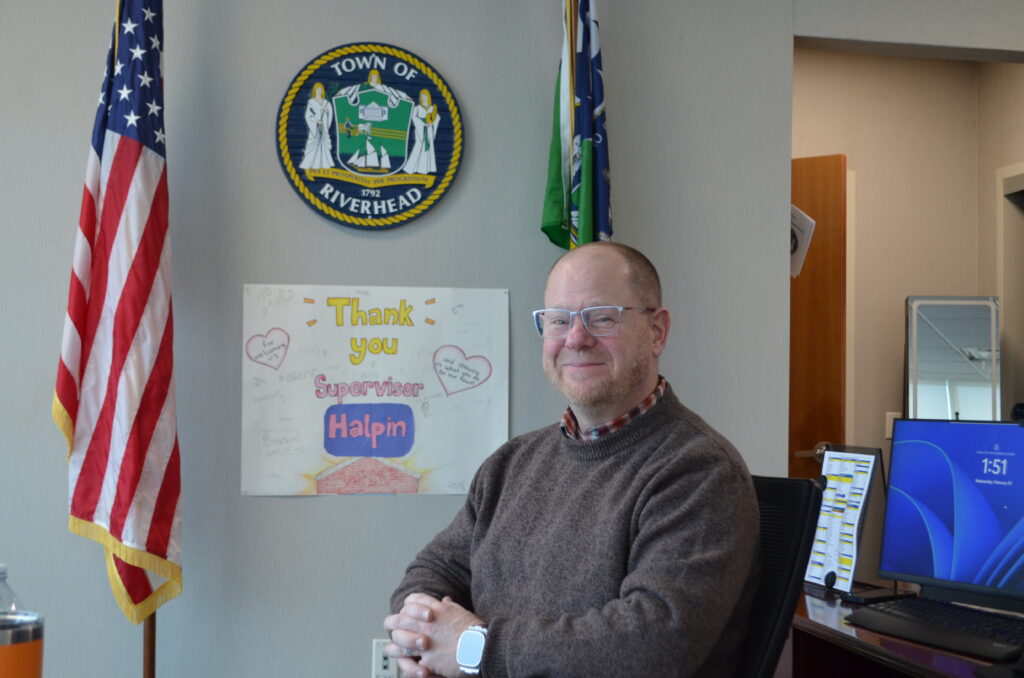
Stepping in as a newcomer to politics and town government, Riverhead Town Supervisor Jerry Halpin has spent his first weeks in office trying to get a feel for the lay of the land.
The former head pastor at North Shore Christian Church — an independent who ran on the Democratic line in November — defeated incumbent Tim Hubbard by just 37 votes. Since taking over the supervisor chair, Mr. Halpin has had to weather multiple blizzards — some of the worst the region has seen in years. He also inherited litigation battles but, in his two months in office, he has already seen some wins.
In the supervisor’s office itself, he was adamant about keeping seasoned employees like deputy supervisor Devon Higgins and chief of staff Debi Burkowsky on his team, which he called “a home run.”
His approach in this new leadership role is to be observant, to listen to those with more experience or knowledge, foster relationships within the Riverhead community and beyond and, most of all, lead with care and compassion.
“It’s been interesting, it’s been educational, it’s been fun, it’s been motivating, but at the end of the day, it’s been work and I love work,” Mr. Halpin said. ” We’ve accomplished a lot. We’ve set the tone. The thing that has surprised me is how well the staff has done with the transition and helping me to get caught up to speed in their areas.”
The Riverhead News-Review sat down with Mr. Halpin to chat about initiatives in the works, his long-term goals and other relevant town issues.
Q: How has being in this role given you a better understanding of the inner workings of town government?
HALPIN: I think what’s been helpful is really being able to foster relationships — everyone’s willing to help. I think the inner workings of government are realizing that, all the way up, party lines just diminish a lot. Whether it’s legislation or getting something done or finding funding, caring about the taxpayers is really my goal, and I think that it’s been fun to see how that kind of intertwines.
Q: What have been your top priorities since entering office?
HALPIN: My priorities haven’t changed. I’m looking at the taxes, what our people are paying, and also being able to pay our employees. I’ve begun to look at the budget, looking at areas where we can be smart. How do we figure this out? Where can we get additional funding from the state, the federal government, county, wherever that is.
One of the things I know is that if you build a house on the sand, it falls when the storm comes. But, if you build a house on the rock, it lasts. I’m trying to build something that isn’t just about me.
We’ve looked at things internally to continue to allow Town Hall to be as healthy as possible with the inner workings. As you can imagine, most of [the staff] may have heard of me. Maybe they knew me from a different avenue of life — whether it be Little League or something — but having me in this position in their life changes that dynamic. So, I think allowing them to learn to trust me, that’s been a big priority for me.
Q: How are you tackling the town’s spending and where are you looking to cut costs?
HALPIN: Some people in my sphere now would say that I kind of give “an MRI look” in every department. In these 50 days, I’m still evaluating and looking, but we’ve done some things internally, we’ve made some decisions and are working to make sure that the taxpayers are getting the best representation for their dollar within these walls and making sure we’re looking at decisions that have been made. I think I bring a different perspective, fresh eyes — I just ask a million uncomfortable questions.
Q: How have the blizzards and last few weather events shaped your perspective on the town’s emergency management?
HALPIN: I think that what it’s taught me is that the people who lead in those areas are really good at their jobs. Any new emergency, any new event, should always be a teaching tool, not just a response, but also learning from it. If we think we have it mastered, then we’re just silly.
We’ve hired well, and we continue to hire well in our town. That is one of the reasons that we want to create new revenue, so that we can keep them.
From the first storm to this storm, I learned some really good lessons right away. I learned to listen better and trust the people that are doing it. I’ve had really some phenomenal people that I work with, so trusting has been easy.
Q: In your first 50 days, you have also had to tackle other emergencies and litigation battles. What is your approach to handling these issues, for some of which you may have to make more immediate decisions?
HALPIN: Growing up with my father who was a fire chief, when they would show up to a scene with multiple people, you begin to triage [and ask] what’s the most vital? I’m doing that with the guidance of different people around me, whether it be the council people down the hallway. I think we have a very serviceable relationship, I enjoy my time with [the Riverhead Town Board members]. Even the person who will be running against me — that’s not an unworkable relationship. We both want what’s best for the taxpayer.
My office staff, the different people in this building. Getting out, seeing them, going to the departments and listening — that helps me to triage. I think some of the people who are outside these four walls, outside of our ZIP code, thought maybe because of my newness they would be able to take advantage of that, or they’ve witnessed my personality. I have said a couple of times, ‘Please don’t mistake my kindness for weakness,’ and they’ve learned that’s true.
Q: Being an independent who ran on the Democratic line, has that political affiliation changed the dynamic with the Republican Town Board members?
HALPIN: There’s not an agenda here, on either side, that I have found to day 56. No one claims that, no one walks that line. We want to work together. We have differences and different opinions, and we voice those.
I have been asked to run those meetings. I’m no stranger to that from my past world, but they’ve been very good to me. Even on the dais — a couple times, maybe I’ve skipped something, and they’ve been very kind and workable. Even behind closed doors, we go into executive session. We’ve had great discussions. We may not begin agreeing on something, but we come to a resolution. We listen to each other and are very respectful. I’m hoping, with all of my might, that continues the entire time, all the time.
The reality is that humans sometimes differ, but I think as long as we keep the taxpayers first, that’s the most important. And they are. I like our board.
Q: What are your ideas for the EPCAL rail extension? How do you think this will be an economic driver to the area?
HALPIN: I’ve kicked the idea around. Are there hurdles? Absolutely. Did somebody try this in the past and not be able to get it across the finish line? Certainly, but today’s a new day. I’m a different leader, and Long Island’s in a different position than it was those years ago. We’re gonna work towards it.
The benefit to Riverhead is it provides us an opportunity to create manufacturing jobs right here at home. And it’s not ‘ash or trash.’ It’s basically a freight rail, and you would see it as an extension of what we already have there.
If we can do this, it brings more commerce and manufacturing to the East End. It will then allow us to hopefully bring the LIRR to our [Transit-Oriented Development] area. We want to continue to put pressure on them, to bring more service to Riverhead and beyond.
Q: When we spoke at our roundtable before your election, we asked how you planned to look after the security of Riverhead’s large immigrant population. You stressed you did not want to lean on opinions, but statistics and facts, before making an educated decision. How are you implementing this approach when it comes to addressing current concerns around public safety and the uptick in ICE raids in the region?
HALPIN: I believe that our police department does a phenomenal job, and they continue to do a phenomenal job. Immigration continues to be a federal matter. It always has been. For the last 56 days, I have been inundated and focused on making sure of those local matters.
All of my conversations with our police chief. All of our conversations with the other town supervisors, mayors, the police chiefs from the towns that I’ve spoken to, we continued to talk about how we are all aware that — no one wants a bad person in their neighborhood — and that they’ve continued to handle our local law enforcement. The federal agencies are proceeding legally like they’re allowed to. Our departments, every day, are continuing to make sure that our residents are safe. Everyone who enters and drives through, they’re here. They continue every hour.
I grew up in a house where there was a scanner on 24 hours a day. Having that radio and listening to our scanner on a regular basis — even through the blizzard — being reminded of, not how busy they are, but how involved and caring the Riverhead PD is. When people ask for different things involving our PD, whatever people’s opinions are of that, what I know is that we’re not notified before ICE comes to town, no matter what people think.
If it’s the marshals’ office with some other thing, [the Riverhead PD does] assist in those areas, so I’m not going to withdraw them from that opportunity. They’ve worked with the county and state to find people from cold cases. People have to understand that it’s a very dynamic, living organism that works throughout.
I’ve spoken to all of the other supervisors that have more experience than me — that are Democrat-run boards — and they’re standing pat with that as well. I’m continuing to learn and educate, but as of today, we’re still holding to that policy of our local PD is working to make sure the town is safe every day.
Discussion is discussion. People want me to lead as they see fit, or make the decisions they want. What I can tell people is I’m continuing to make the best decisions we can. Together, collectively [and] lovingly, with that in mind.
It’s definitely had an impact on me, as a person. This is a continued talking point, it’s not going away.
Q: How has your shortened supervisor term impacted your decision-making?
HALPIN: Honesty, it has not. When you lead from a sense of urgency with that kind of thing looming over your head, it can create a sense of disorder or panic. Or, making decisions that would benefit me, and that’s not how I want to lead. I want to lead with a decision for the taxpayers. For next year, for the next 20 years down the road, because I’m a taxpayer. I live here, and I like it here, so that’s really the basis of where I am.
I do celebrate the wins, and I love the wins. The incremental wins, the big wins that we’re working towards. I can’t wait to tell you in 100 days more about some of the stuff we want to bring to town.
Q: You’ve talked a lot about the concept of ‘failing forward,’ and giving yourself grace when making mistakes. When mistakes are made, how do you want to make the most out of them?
HALPIN: I want to be able to go directly to somebody if I’ve done something and apologize. I’ve done that more than once since being in office. I don’t have any problem doing that. Building those relationships, letting the person know I really care about them as a human being, and their role, whether here in Town Hall or the roles around us. But, understanding where I made that mistake, and then being able to grow from it.
You can believe the words coming out, people don’t have to trust me. I’ve had someone sitting in the chair [across from me], and I said to them, you only have to trust me for a year. If I fail you, you don’t have to trust me again, but give me a year.