Riverhead, Southold officials question North Fork pipeline
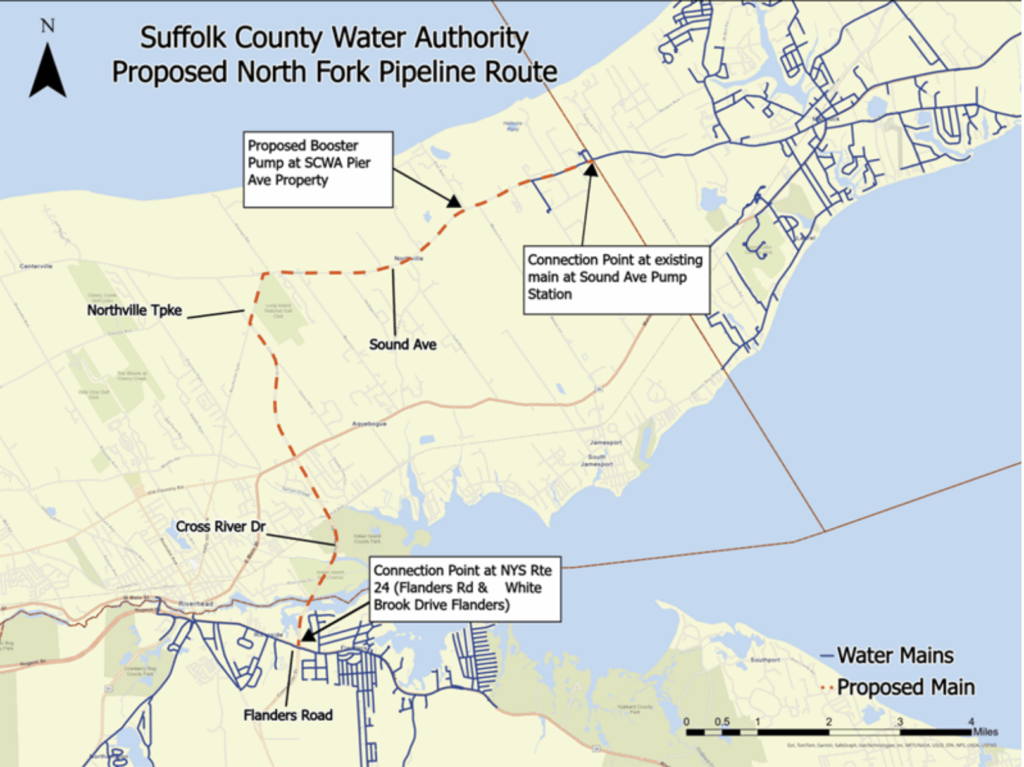
Riverhead and Southold town officials questioned the benefits of Suffolk County Water Authority’s proposed $35 million 8.15-mile pipeline from Flanders to Laurel during an informational meeting at Riverhead Town Hall on Aug. 13.
Concerns expressed by Riverhead officials and consultants included confusion over the exact placement of the water main extension, a lack of inclusion in planning of the pipeline, and a general distrust for the consideration of local impact of the project.
“There’s virtually no other information other than this line on a map, which makes for me, as an analyst, very difficult to determine what the impacts might be and also what they really should study in the scope,” said Jeffrey Seeman, environmental consultant for the Town of Riverhead.
Mr. Seeman added that no tax map numbers had been provided to Riverhead Town to evaluate whether the project would go through private properties with underground infrastructure such as gas lines or existing water lines for the Riverhead Water District. Impacts of the pipeline could stand to affect Riverhead’s own development plans in the future, he posited.
“We have been requesting that information, and we haven’t received anything yet,” Mr. Seeman said. “And to put it in the draft impact statement is a little late, to say the least.”
The notion that Riverhead Town has not been treated as an involved agency for the proposed SCWA pipeline is something Mr. Seeman disagreed with on the grounds that “all of the land that this will run through in Riverhead is owned by the town.” He compared the project to someone building a fence on private property, with the property owner not having a say in the height, construction and placement of said fence.
“I don’t think they are up to speed on the requirements of really what the SEQRA standards are,” Mr. Seeman said.
Riverhead Town will conduct its own Monroe Balancing Test on Tuesday, Aug. 19, at 6 p.m. at Riverhead Town Hall to determine whether or not, and to what extent, the SCWA pipeline project may be exempt from local zoning and land use regulations. The test was originally developed in 1988 after a New York Court of Appeals decision between Monroe County and the City of Rochester.
It is a nine-pronged test that weighs a host community’s impacts, effects on local government authority, land use regulation, the potential of improvements, and the extent that the public interest is to be served by the improvements, among other considerations.
“The SCWA’s initial position on this was that they were going to conduct a Monroe Balancing Test through their DEIS scoping, which I believe is legally insufficient and procedurally improper,” Riverhead town attorney Erik Howard said.
The decision to list the Town of Riverhead as an interested agency instead of an involved agency in respect to the project is something Mr. Howard said is a “majority deficiency in the proposal.” He added that the pipeline, meant to service Southold and improve its water infrastructure, is something that would not serve to benefit the Riverhead community.
Southold Town Councilman Greg Doroski noted the importance of both Southold and Riverhead towns working as “a unified front” on this matter.
A similar informational meeting was hosted in Peconic in June where community members listed hundreds of concerns about the pipeline — concerns that Southold Town officials noted and submitted in a six-page questionnaire to the SCWA, Mr. Doroski said.
“There is a fundamental question for us all to ask, you know, ‘Whose water is this?’” Mr. Doroski said. “They’re taking water from Southampton, bringing it through Riverhead to serve Southold.
“I think we need to look at this together, because it’s not just about this one well; I have similar questions whether there is capacity in that individual well to supply the water that they say they need now and potentially in the future,” Mr. Doroski said.
Southold Town Supervisor Al Krupski commended Riverhead for its informational and municipal efforts regarding the pipeline project. He said some of the concerns Southold officials brought up regarding the impact on Southampton and Riverhead of the proposed project have not been openly discussed.
“For anyone to propose to move water that far, through different boundaries and through different watersheds and different aquifers, without considering the work of the United States Geological Survey, doesn’t seem to make any sense at all from a resource management standpoint,” Mr. Krupski said. He stressed the importance of considering the recent scientific studies when creating the project plan.
“There’s a finite amount of water,” Mr. Krupski said. “I don’t know who’s done the work to really determine is that enough water.”